All photos dedicated to the city. Happy Birthday, Moscow!
Everyone gets to answer the question, at one point in one’s life, at least once. ‘What do you want to be when you grow up?’ On my personal wishlist, over the years, there were the following: a ballerina, a doctor, a woman (the first one), a plumber (that is the latest, my plan for the retirement years) and…a teacher. No idea if that means ‘no ambition whatsoever’ or ‘achievable aims’ but nevermind that. I am a teacher. Yay to these dreams that come true, tick!
I have been planning to write this post for a while but I’ve been struggling and what I ended up with was either a lot of sentimental waffle or some lofty speeches worthy of an educational Thomas Moore. No, thank you. Instead, I am going to hide behind a few stories, hoping that they will collectively illustrate why one might want to become a teacher.
There is a boy in this story, a local troublemaker, who actively spent his school time making his teachers’ life ‘interesting‘ for three years straight. There is always one of these in every class and someone has to be their teacher. The teacher and everyone else survived.
The same boy, fifteen years on (15!), meets the teacher’s brother at some kind of a social do in the hometown. ‘I was a nightmare at school‘, says the boy, already an adult, ‘Say hello to your sister and pass on my apologies‘.
There is another student, a girl this time, that the same brother meets at another do in the hometown. This student, years on, also asks the brother to pass her regards. ‘I don’t remember many teachers from the school.’, she says, ‘I do remember her. She was cool.’
There is an adult student, Olga, who gets in touch via Instagram and it turns out that she is also a teacher now and that seems to be inspired to become a teacher of English in the teacher’s classroom, about ten years earlier. And it nothing short of touching…
There is the first student ever, her own cousin, Magda, and the lessons which were based on pure enthusiasm and on intuition because the teacher was more of an ugly duckling and not yet a real professional. Now, imagine this teacher’s emotions when, a few years later, she was sitting in the hallways of the university, waiting for Magda to pass her final exams and to be awarded an MA in English and Translation.
There is a teenager, only a year ago, at the summer camp. This teenager fills in an anonymous feedback form and in her commentaries on the English lessons writes ‘I’m not scared anymore‘. To be honest, that reduces the teacher to tears because, really, although the lessons were good, she thinks ‘Ihave not done anything special‘, and yet, that seems to have made a difference.
There is the little girl, Sasha. After one of the lessons, this little girl comes up to her teacher, looks at her with a very serious face and says: ‘Anka, thank you very much for preparing such interesting activities for us‘.
It’s been a good few years already but the teacher still hasn’t recovered from the happy shock that this conversation was. The little people hardly ever do that. They will go for it, they will take part and leave the classroom happy. Sometimes, they might bring you a dead ladybird or donate the only balloon they have. Sometimes they may actually confess ‘Я Вас люблю‘.
Very often, though, as soon as they leave the group or change the school, they simply forget. Just forget. I like to think that they make room for new memories and new information. Out of sight, out of heart, without any metaphors. And no honourable mentions on the social media. But that’s ok, that’s simply how it is and it doesn’t matter. The teacher knows anyway that maybe she will not be remembered, but she did make a tiny little bit of a difference.
But there is more than just the blast from the past, more than just memories. There are the kids in the classroom, here and now. It is a good feeling to be looking at their progress test results. It feels great when they come back in September and proudly show the certificates they got from Cambridge.
It is even more beautiful when during the most regular lesson, you realise that the shiest and the quietest teenager in the world now leads the debate and presents winning arguments, with the confidence that could move the mountains. Or, that the student who entered the classroom five years ago to learn her first words, now is telling everyone about something that happened at school that morning, a hilarious story from the cafeteria, with the narration and the dialogue, with only a few grammar hiccups which are still to be expected since it is only A1 and she is only 9.
So, for a moment like one of these, the teacher is still a teacher.
And, now, as a reward, since you have lasted until the end of this post, here are all the articles that might come in handy in September.
This post is dedicated to all the teachers who soon are going to be entering the VYL or YL classrooms for the first time ever and are now wondering how to prepare for that.
Why?
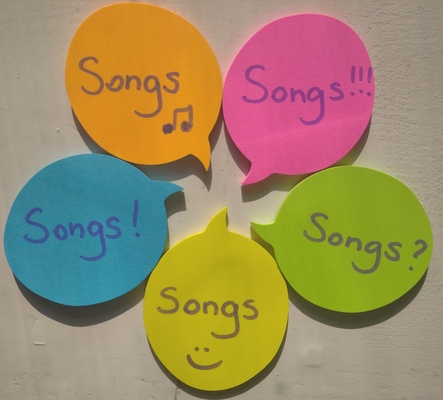
Songs are definitely the resource that a teacher should use while teaching primary or pre-primary. A while ago I have tried to collect all the reasons to sing a song in one post (the full list here) but if you have never sung before in the classroom, here are the five most important reasons
songs will help you create a framework for the lesson, something to begin with, something to finish with, some nice punctuation marks in the lesson
they will be the easiest way of changing the pace of the lesson. Even if the kids don’t participate fully from the very beginning by singing, the song itself will work as a stirrer (or a settler, if you choose a very calm and peaceful one)
they will create an opportunity for the children to participate, at least with movement and gestures and, depending on the song, even with a few words or structures
songs are something that we all do together so they will help you ‘unite’ the group after the tasks on which the kids work individually and they will help to create a community
you can share them with the parents, to listen at home, this way taking English out of the classroom
Some do’s and don’t’s
Staging a song lesson for pre-primary or primary should, in fact, be a separate post, because there is a great variety of techniques and activties that can be used. For now, I can recommend having a look at this post here as well as the five tips.
Listen to the song before the lesson and get ready. Plan how you are going to introduce it. Simply pressing the PLAY button and saying ‘Let’s sing’ is not going to do the job with songs in the EFL / ESL classroom.
Play the video. It will really help the kids understand what the song is about.
Sometimes they are already in the song and in the video, sometimes not and we have to come up with a set to use with each song. It is something worth investing your time in because the gestures will help the kids understand and remember the lyrics. What’s even more important, especially in the first lesson with a new song – gestures will give the children a real opportunity to participate.
Sing yourself, do all the gestures yourself. And with a smile, too! Even if you are the only one and even if the students don’t join you straight away. It is perfectly natural, they need time to get used to the music, the lyrics, the gestures, the rhythm. Plus, you are the leader! If you don’t get involved, why would your students?
Share the song with the parents and use it again. A song is never just for one lesson.
My favourite hello songs
Hello. Super Simple Songs – a real hit and a good start, with 6 emotions, including ‘not so good’, to show the kids that it is ok to feel not happy, sometimes.
Hello Song. Fun Kids English– another good one, with monsters, there are actually two parts of it, each with 4 emotions. It is good to have a new version when the kids get bored with the first one.
Hello Song For Kids, The Singing Walrus – I love it because it includes not only the hello questions but also some Present Simple sentences and questions about the everyday school routine (‘Everyday I go to school) and each of them is repeated twice, in the classroom it can be T and then kids. Lots of potential.
Hello Song for Kids, EFL Kids Videos – very simple but very energetic, lots of repetition but also a nice variation of verses sung loudly and quietly. We loved it.
Hello Hello! Can you clap your hands. Super Simple Songs – another simple one with a few movements, perfect if you want to get up and move a bit
My favourite goodbye songs
Goodbye to you! EFL Kids Videos – using the same melody and the same pattern as the hello song from EFL Kids Videos, helps to save the time and works both as ‘something old’ and ‘something new’
Bye Bye Goodbye Super Simple Songs – a kind of a follow-up to the Hello Hello Can you clap your hands, the music is different but the song uses some of the verbs.
Goodbye Song for Kids, The Singing Walrus – this one is a bit more complex, but again, as their hello song, it uses full sentences. Lots of potential.
See you later, aligator, Super Simple Songs – a very short one, includes gestures for alligator and butterfuly and if you want, it can go on forever.
My favourite movement songs
Head, shoulders, knees and toes, Super Simple Songs – everything you may need in your first lessons, just getting up and moving a bit, even if the topic of body parts is scheduled for some other day
Move. Dance Song For Kids. Super Simple Songs – my latest discovery, lots of movement (verbs), a great melody. It can be used partially ie the first three parts of as a whole. It can be also extended if kids have their own ideas.
Jump, Run and Shout. The Singing Walrus – another energetic, rock song with movement. Just like Move, we like to sing it in the beginning of the lesson. It helps to get rid of lots of energy.
The Jellyfish Song. Super Simple Songs – a simple but effective song, very little langauge here, you are going to be pretending that you are jellyfish. Somehow, the kids get a chance to move but also to calm down.
Shake Your Sillies Out. Brain Breaks For Kids. – this is one is for older kids, lots of great ideas here and quite tiring, when used from the beginning until the end, but my kids loved the idea of ‘shaking the sillies out’ or ‘clapping our crazies out’ (very necessary on some days) so we only used the movements, not the song.
My favourite randomness
Open Shut Them, Super Simple Songs– one of my favourite songs ever because it teaches adjectives and opposites (somehow neglected by many of the coursebooks and programmes) and you can easily include gestures. Plus there are four parts of it which means that a new one can be added as soon as necessary. Open Shut Them can almost become a part of the classroom routine for the whole year and later on, the teacher can even extend it by creating own versions.
Hickory Dickory Dock, Super Simple Songs – some counting, some animals and an unexpected ending.
What’s your favourite colour? Super Simple Songs – first of all, it can be inroduced from the beginning of the course (colours), it can be used as a game (to point at different colours in the room as the come up in the song) and, last but not least, it contains a great Q&A set (‘What’s your favourite…?’ ‘I like…’) and it can be turned into a real conversation and easily extended into other topics, as they come up i.e. toys, numbers, pets, letters.
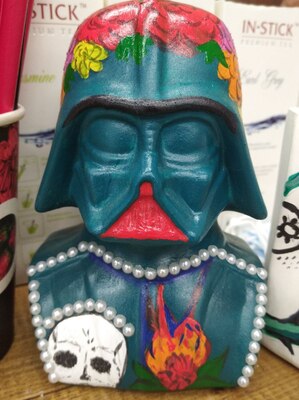
My name is Vader, Darth Vader. I am a teacher and a teacher trainer, I work with VYL and YL teachers.
Well, not really. I would like to think that, as a trainer, I smile a lot, I am supportive and open to questions and debates and I only shout at football matches. But there are those moments, on the courses that I teach or just in the everyday mentoring life, when I feel I am taking on some of Mr Vader’s traits. Although even then it is more in the style of the Darth Vader in the photo above.
One of those Darth Vader moments is defnitely induced by some of the concepts and beliefs related to teaching English to young and very young learners. They are out there, in the world, and although they are entirely ‘wrong’ or ‘incorrect’, they have already become some EFL YL clichés that can cause more harm than good.
In the post below I will share with you my top five ‘Think Twice Concepts’ in the early years EFL. A very subjective approach, I must warn you. Are you ready? Fasten your seatbelts! Let’s go!
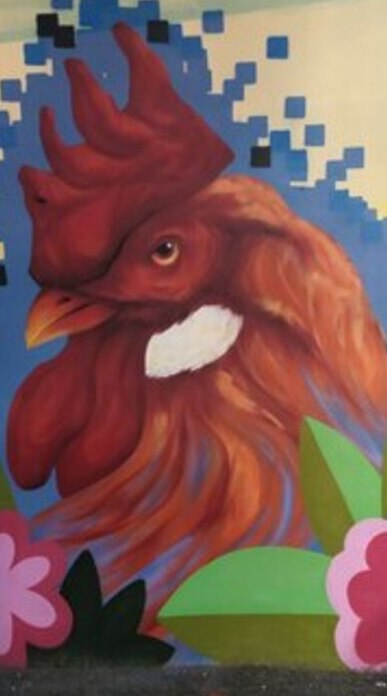
courtesy of Юлец
Bad behaviour
There is nothing that could be labelled as ‘bad behaviour’, not in the EFL classroom full of pre-schoolers. There is curiosity put to practice, there are emotions in action, there are boredom- induced replacement activities. There is fear that materialises itself as agreession and a general lack of goodwill. There is tiredness, hunger, possibly, or, on the contrary, the high levels of sugar from the chocolate bar eaten five minutes right before the lesson or the memory of the morning visit to the doctor and the unpleasantness of it that still lingers in the air (although the arm really did stop to hurt after a jab about three hours ago). There are, also, plenty of examples of ‘I will do what I have always done in such situations and if it has always worked so far with mum, with nanny, at home, at pre-school and at the playground, it is bound to take the required effect here, too!’
There is no bad behaviour, although sometimes we get to deal with ‘the unwanted behaviour’, that might be getting in the way of our lesson or other children’s physical or mental well-being.
Solutions: first of all, react, ideally to stop this unwanted behaviour, or, at the very least, to signal that it is not what we want to have. If one thing is certain, it is that it is not just going to happen, all by itself. Then, after the lesson, when everyone has already left and when the dust has settled – reflection. Was the first time that it happened? Does it always happen? Is there any chance that some triggers could be identified? Was it in anyway related to the activities, to what the teacher did, to what other children did? What happened later?
It is always a good idea to talk to the parents or carers, too. Not to complain or to blame the child or the adults but mostly to understand what really happened and why. And perhaps (but just unfortunately ‘perhaps’) this information will come in handy the next time it happens.
Egocentric
I don’t think I will ever be able to forgive Piaget for using this particular adjective to describe the little kids’ attitude to the world and to the people in it. It is a perfect example of a concept created by adults and used to refer to people who are not adult yet and whose attitudes and reactions are what they are simply because they have not had a chance yet to grow and to develop fully. In the EFL terms, it would be like sending a seven-year-old beginner to take an FCE exam and then scolding them for failing while they are simply not there, not yet and they should be seen nowhere near the exam room.
Of course, pre-schoolers might struggle with sharing the box of crayons, they might want to always be first and always hold the teacher’s hand. They may not like to sit next to Pasha today and they will not want the other children to touch the car they brought to class, to show off a little bit. They will not be happy about leaving their picture in the classroom for the teacher to display on the noticeboard. And they will all want the princess flashcard. But all of that happens because they are just learning how to be a person in the world full of people and a person in that particular group of children learning English.
Solutions: The most important of them comes from Mick Jagger because, indeed, ‘Time is on my side, yes, it is!’. The group of children starting to study together in September will be changing, from lesson to lesson, and even after a week or two or three, they will be a completely different bunch, only because they have had a chance to interact with each other, to do something together and to find out that a group is not Anka and five other someones but Anka and Sasha, Pasha, Kirill, Mitya and Olya, some of whom we like a little more, some of whom we like a little bit less.
Apart from that, there are also all the tricks that the teacher can use throughout the course, to help the little people bond and start noticing the other children and start to learn how to share the lesson with them.
So, no ‘egocentrism’ but ‘social skills that are still developing’.
A typical five-year-old child…
Apart from the knowledge of the language and the knowledge of the methodology, the knowledge of the child development stages is one of the three areas that an EFL teacher working with young learners needs to be familar with (Mourão, 2018: 429) and it is great to see that a summary of these characteristics have made it into the professional literature ( Mourão, 2020: 33 – 39) and are easily available online.
At the same time, there is a danger that teachers will be looking into these and applying them too religiously, without considering the differences between the individual children. As Mourão (2020: 215) says ‘Children develop holistically, show individual differences in development and progress at different rates’. That means that even if we had a group of only five-year-olds, all of them coming from similar environmenta and all of them provided with the same opportunities and, even, why not, all of them born on the same day, they could all develop their cognitive, motor, social or linguistic skills at completely different rates. As a result, despite the fact that the group would be theoretically homogenous, a teacher would still have to deal with a mix of abilities. It seems that a teacher equipped with a little knowledge and induced by this knowledge expectations of the children and of the lesson might be even more damaging that no knowledge at all. Because typical five-year-olds don’t exist.
Solution: an open-mind and an organic approach to the little people sitting in the classroom. Instead of applying strict frameworks and checklists and trying to make the kids fit in the tables (which they are more than likely not to be able to do, as a group or as individuals), reading and researching the age group in a close connection with the specific students whom we teach at the moment.
Short attention span
This is, without any doubt, one of the most important differences between an adult and a child learner and this is the one that gets highlighted most frequently. For a reason, too.
However, at the same time, any attempt at specifing what that attention span is or, even more, at quantifying is, simply, pointless. Much as it may give the (false) impression that once the concept has been assigned a number, it is not as scary and it will be easier to deal with, especially for those of the teachers who have little or no experience of working with the younger children. It is from them that I often hear that ‘an activity should not take more than five minutes’ or, even, ‘it is the child’s age plus one minute’.
Well, I wish it had been that straightforward.
In real life, the attention span will be very much dependent on a number of factors that nobody is able to predict or enlist, and, as such, it is simply impossible determine once and for all. Children’s attention span will be related to their age, to some extent (although it will materialise itself in a way unique for each child) but it will also be affected by absolutely everything that might have had an impact on the children’s mood before and in the lesson and the teacher’s mood before and in the lesson. Such as? Such as the first snow of the year, a spider in the classroom, a visit to the doctor just before the lesson, a swimming lesson just before the lesson, a birthday party attended, a grandma’s visit, candy eaten before the lesson…Or a teacher who has had an especially tiring or stressful day, any malfunctioning technology or a handout lost. Any of these and the tried and tested activity that has always worked with the same group or the same age group, that has had the kids in awe and involved for five or even ten minutes, can quickly turn into a failure or the most boring and unappealing activity in the entire world.
Solution: first and foremost, switch off your adult thinking of what happens in the classroom. The kids, young or very young, they will not be just sitting behind the table, patiently waiting for you to start what you have prepared for the day AND they will not stay involved in it for a prolonged period of time as long as you think they should. Second, while planning a lesson, think about it from your student’s perspective and ask yourself what your students might find interesting about an activity. Is there anything that would motivate them to engage in in? Anything else that just the mere fact of this being an activity done in a lesson.
Then, in the lesson, itself, keeping your eyes open and adapting to who (and in what state) you have in the classroom on the day is the best way of dealing with all the implications of the short attention span. And, although I would argue that this applies to all the age groups and levels, being ready to let go and teaching the students and not the plan, not the coursebook, not the handout and not the activity.
‘They don’t like singing’
Sorry, permission to disagree here and yes, even before I have seen you in the classroom and before I have met your little students. I don’t think it is true, simple as that. Why do the teachers say that then?
Partially, it is because, again, the adult perception of what song and singing is and should be gets in the way. On the one hand, when we listen to songs in our non-teaching life, we do just that, we listen and take pleasure in it, hopefully. There is nothing wrong with it, and, indeed, I believe that listening for pleasure should be sometimes included in our lessons, too. The only ‘problem’ with very young learners is that they might not be familiar with that kind of an exercise and after a minute or two, with no other task, they will be getting bored and distracted. And, possibly engaging in other, unwanted, activities.
On the other hand, when we use songs in the EFL lessons, we expect the students to sing these songs and in case of pre-schoolers or even primary school children, it will take them for them to master all the elements of the song, the music, the rhythm, the lyrics, before they are actually ready to sing. If the teacher expects a real performance in the lesson in which the song was introduced for the first time, they will be disappointed. Again, the children might remain focused for a minute or two and then, again, they will find something else to do and the teacher will arrive at a conclusion already mentioned in the heading to this paragraph.
It is true, that the word ‘singing‘ could be replaced with absolutely any type of a YL activity, ‘craft’, ‘miming’, literacy’, ‘animals’, ‘this game’ and the implications would be the same or almost the same. It is also true that music-related activities are more likely to feature here. Mostly because teachers often worry that they themselves cannot hold a tune or that they are not confident enough to sing in front of others.
Solution: forget about you and your pre-conceptions, your teacher previous knowledge and try. It might be that you yourself are not the world greatest fan of Baby Shark and of pretending that you are a…melting ice-cream (btw, one of the real ideas suggested for the miming game by my students) but the simple truth is, if the teacher does not make an effort and if the teacher does not get properly involved in a song or in an activity, it is almost a given, that the students will not, either. Especially, the little ones. And, really, the most amazing thing about the VYL audience is that they really do not care whether their teachers sing well or badly. The only thing that matters is whether they put their hearts in it or not.
And as for the other problems, be it music or craft, scaffolding and lesson planning is the answer and no two ways about it. If you need any more convincing to why we should use songs with children, please have a look here and if you are looking for some ideas of what can be done with a song to maximise language production, you should definitely look at this post here.
Coda
This post is not only about me having a little venting session on a Monday morning. It is not a critique on the people who use these terms and it is definitely not about my ‘What not to say’ list that I will be handing in to all my teachers and trainees from now on.
I decided to put this post together because it seems that all these clichés start in the very same place and that is when adults try to apply adult categories, labels and concepts to children and to how they see the world, how they learn and how they grow which might lead to misunderstanding, confusion and frustration in the classroom.
Perhaps there should be one more thing added to the list of skills and areas that a VYL or YL teacher should be equipped with, apart from the three mentioned by Mourão (2018)? The knowledge of the subject and of the appropriate methodolody is absolutely crucial and so is the awareness of the child development stages. They are an absolute must and a starting point. Still, they are going to be of little use in the real life if a teacher is not going to be willing to switch the perspective and to try to see the lesson and everything that happens in it from the point of view of a three-year-old or a seven-year-old.
As everything in teaching, nothing happens overnight, and it takes time to develop the ability to observe and to analyse your students and their behaviour and to learn from that. The good thing is that the very willingness to accept the fact that a different perspective is needed is already a big step towards success.
Sometimes, changing the perspective physically can make a real difference, too. In our teacher training courses, we sit at the big tables (of course, we are adults!) but there always comes the time when we transfer to the little stools in a small circle. We do it to practise different games and to reflect on them but this is also a great opportunity to experience how the furniture and the set up can influence the activities and the emotions.
This blog post can hopefully be a good first step, too!
What do you think, dear reader? Are there any other terms that you would add to this list? Please leave your commetns below!
Happy teaching!
P.S. All the amazing animals in the photos live in the streets of Yaroslavl. Mr Vader found a home in a coffee shop Free-da there. All photos – mine, apart from the rooster taken by Юлец and used here with her permission.
References
Development Matters in the Early Years Foundation Stage (2012), to be downloaded here
Mourão, S. (2018), Research into teaching of English as a Foreign Language in early childhood and care, In: S. Garton and F. Copland (eds), The Routledge Book of Teaching English to Young Learners, Milton Park and New York: Routledge, p. 425 – 440.
Mourão, S. & G. Ellis (2020), Teaching English to Pre-Primary Children, Stuttgard: Delta Publishing
What do you mean you can’t suddenly land on Mars? Sure you can! You get ready for something else, as far from space travel as only possible, you arrange all the bits and pieces, you make your copies (because you assume you are preparing for teaching) and then, suddenly, due to a combination of factors (although the Russian phrase стечение обстоятельств somehow fits better here), you open your eyes, you open the door of what turns out to be a rocket and, ta dam, you find yourself on Mars!
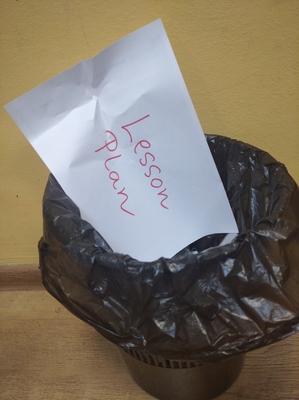
Naturally, everything that you have prepared, on paper or in your head, is, all of a sudden, absolutely useless. The whole lot of it, so, immediately, it lands in the bin or, what we refer to as with my kids, ‘Our Tresure Chest’. Hence the photo.
Congratulations! One of the most amazing adventures of your teaching life (probably) is about to start in…3…2…1…
What really happened?
It was supposed to be a short summer course, for kids, primary, whose main aim was to be a revision and reinforcement of everything that the kids knew, based on games, speaking activities and project. It was a programme I prepared myself, a programme I had run in the past, a programme that had been tried and tested. There are no coursebooks.
However, on the day, due to this amazing combination of factors, all of a sudden, there are four great kids sitting in the classroom, a ten-year-old, a seven-year-old, an almost-seven-year-old and a five-year-old. As regards the levels, one of them is more of less a Starters level and three false-start beginners which means that they know an occasional number, a few colours and a pet or two. Plus, they have had some exposure so, rather than run away, they make an effort to listen and to follow instructions.
Of course, since it is the first day, they trickle into the classroom (a new routine is building up, also for the parents) and the lesson takes off three times in a row. It is an interesting feeling to become aware of the fact that the lesson is 120-minutes long (or very very long), especially when you have nothing ready.
By nothing, I mean ‘literally nothing’. All of the materials and the lesson plans I had prepared were lying on the nearby table, I could see them from the corner of the eye throughout the lesson. I knew that they were entirely irrelevant at the moment and that maybe, if I am lucky, I might use them later on, with some other group. Maybe, not during this particular lesson that I was very much a part of and responsible for.
What I learnt from this experience
Spoiler: Plenty.
First of all, finally, I was able to pinpoint what ‘being experienced‘ means. It’s been a while since I started teaching and another while again since I could label myself as ‘experienced’. At the same time, I have never really thought what exactly it means to me. Because, normally, you don’t think about it, do you? Unless, sometimes, you are asked to add the number of your teaching years while putting together a bio for one conference or another…Or when you bump into ‘a student of yore’ and you notice how much they’ve grown. And how much time has passed.
I was teaching, peaceful and quiet, thinking that ‘It’s ok. Everything is going to be alright. The patient will live’. I was not happy because I really hate coming into the classroom not having planned my classes. I was not excited about the potential challenge and an opportunity to experiemnt and learnt. But I was angry, scared or even stressed out, just teaching. Anyway, the kids were in the classroom already so, if not for anyone else’s sake, it would be recommended that I behave for them. I don’t know if it works for everyone in the exact same way, but for me, yes, the students’ presence (insert here: kids, teens, adults, trainees) has a calming effect on me. All in all, that would be the definition of ‘experienced’ for me.
Then, this particular lesson (or the course) has made me think again about the case when students, who belong to different age groups but study together. Of course, there is a reason why we take these two factors into consideration: the age and the language level and we want to provide the best service, always suited to the individual students’ needs. There is no doubt about that. However, at the same time, over the years, I have been in a situation when the younger were together with the older and it did work. Because it did work in that case, too. It has worked, rather, (we are not done yet) and I am trying to understand why and how.
I don’t fully understand it yet, I am collecting evidence, so to speak, but whenever that happens, I always think of siblings playing together and doing things together, despite the age gap.
The most interesting part of it was the teacher’s brain at work. At one point in the lesson, I realised that it was working on as many as four levels simultaneously. One – because I was actually fully involved in the activity that was taking place at the moment, a game that we were all playing. Two – because I was thinking fast on my feet, trying to plan the next few activities, until the break. Three – because there was also the second half of the lesson after the break and I had to plan this part, too and four – because I was doing all that and also reflecting, on the go.
It was not all about killing the time and making sure that the kids leave the classroom alive and kicking, happy and healthy. It was about making sure that the children learn something and that we meet our lesson aims, although, admittedly, these were the aims that were set in the course of the lesson. All in all, it was a successful lesson. We learnt and practised some vocabulary and the kids learnt the room as humans who can use ‘I like’, ‘I don’t like’ and ask the question ‘Have you got?’ because we needed it in a game. If I had been observing this lesson, I would have given myself a ‘To Standard (strong)’ or maybe even ‘Above standard’. What a relief:-)
The only problem with it is that the brain gets really, really tired with such entertainment. As soon as the kids left, I just slumped on the desk and took a 15-min power nap, then lunch. Then, I was good to go, as if nothing ever happened.
Coda and the follow-up
Last but not least, it made me think about all the less experienced teachers and how they might react in such a situation and what I could tell them to help deal with the stress and the students in such a situation.
For that reason, next blog series will be about that, landing on the teaching Mars and surviving. I am planning a post on the top ten resources that might come in handy and that will help to save the world (kind of) and on a three posts in which I am going to share my ideas for the lessons based almost entirely on paper. Soon in cinemas near you!
This is my first wonderful adventure with writing in the area of EFL, with some of the resources and strategies that can be used in the classroom to develop the speaking skills in the pre-primary and primary learners.
There is no need for anything else serious now, not with the amount of work related to the end-of-year procedures, the amount of work related to the summer programmes kick-off or the very important teacher training course that has just taken off. If there are any posts to come in the next few weeks, they will be all of the following kind: light-hearted, frolicky, with a giggle.
A teacher = a chameleon, a teacher = a jack of all trades, a monitor, a manager, a mediator, a diagnostician and a teacher, experienced or not, talented or not, on a good day or on a bad, this very person juggles all these roles and a teacher multi-tasks, playing a few roles at the same time.
But there are the other roles that a teacher plays in the classroom. Here are mine.
I’m a coach.
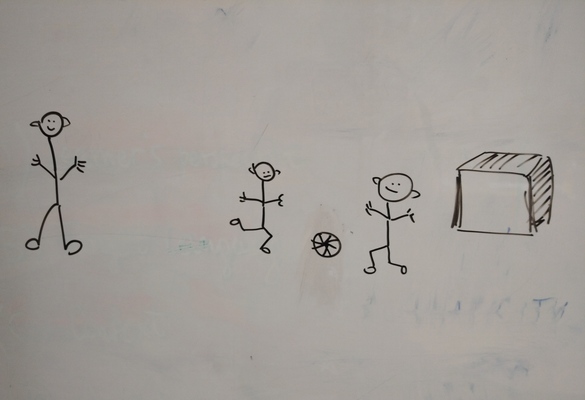
I work hard with my players. Whenever they are there, I am there, at every single training session, those technical ones, those devoted to developing speed and agility, those before the important game. I have been a player myself, I know what it all feels like, I have learnt how to share this knowledge. I am sometimes light-hearted, sometimes very serious but I know what our aim is and I am going to do everything to get us there.
But, at the same time, I am not the one who is going to play this important game. I am preparing my sportsmen but they are the ones who will be performing themselves. I will not be able to be there and always hold their hand, not on the pitch. They will be on their own and they need to get ready for that. Our time in the training session has to focus on that, on giving them skills, developing their independence and confidence. And then they go.
I’m a gardener.
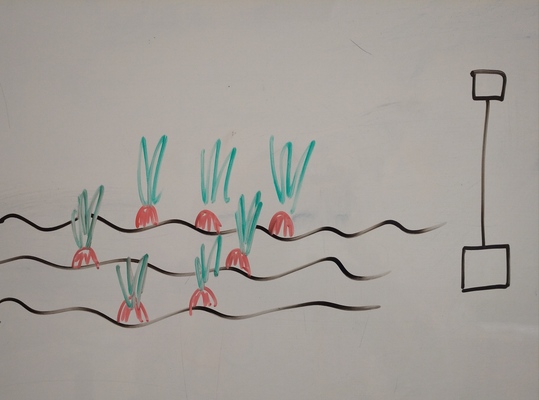
I have my patch, my garden, my orchard. I plant my seeds and my saplings. I hope for the sun and good weather. I water, every day or even twice a way. I protect from the insects and birds. I check out for the weeds. I look and check up on them regularly. I wait. I wait. I wait. I wait. I wait. I wait. I worry about the wind, storm, temperature drops.
After a very long time and a lot of waiting, the day comes when a leaf appears, a flower, a raspberry here and a carrot there. And when it does happen, it is the best day every and I rejoice. And sometimes, I need to water more or move the pot into the sunnier place, or back into the house. Sometimes, I have plant the seeds again.
I’m a (kind) witch.
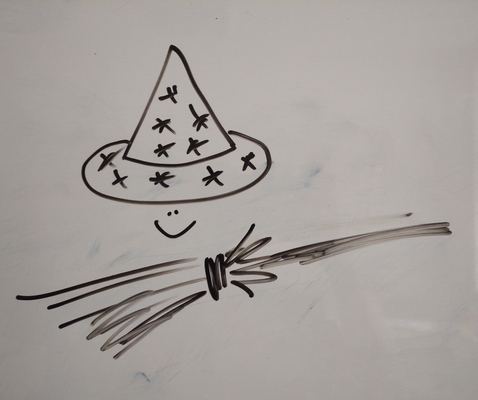
I am sweet (or so I would like to believe, at least when I am in the classroom:-) I smile a lot and I laugh a lot. I can turn a lot of difficult situations into a joke, to disperse the clouds. I wear funky socks and funky masks. Funky earrings, too. I am kind. I laugh a lot.
But I am also a witch and there can be no doubt (never ever) who is in charge, who is the boss and who has got all the superpowers. Which she will not hesitate to use. When necessary, the smile will be put away, on the shelf and the witch will do the witch’s things. If the world really needs it.
I know that these might be also referred to ‘teaching personas’ or ‘teaching personalities’ but I am going to stick to the concept of ‘a role’ here. Because ‘personality’ suggests something more serious (and that’s not the word for today, remember) and something more permanent and these described above are not traits, only characters that one assumes while entering the classroom. They can be different on different days, more or less prominent or obvious, they might appear every day or be held in the cupboards, kept for the special day…Perhaps we change as people because of the fact that we teach and that we teach English and that we teach English to kids and because of how we do it. Perhaps we choose our teaching roles based on what we are. Perhaps both. That is a conversation to be had on another day. Maybe.
In the meantine, if you want to share how you see yourself in the classroom, there is the comment box below. I am really looking forward to reading these.
This entry was initially a post on Facebook a year or so ago but the list has got longer and more interesting since. What’s more, what started as ‘a page in the photo album’, almost, with time turned into a reflection on professional life, early years development and its impact on the EFL methodology.
Based on one million true stories. Enjoy?
These are the things that my students brought to their offline or online classes:
a dead ladybird, handed to me already in the R.I.P state, as the most precious treasure AND a present
ten plastic jungle animals (all of which participated actively in learning and practising of the new vocabulary)
a bunch of toy dragons (which were not ‘angry dragons’, as I was assured)
a toy lion (also very active, answering questions and all that)
a toy parrot, Pepsi (Pepsi always asked for her own homework handout and always did her homework)
baby brothers and sisters who wandered in and stayed
Pasha, the invisible student
a few cats (purring loudly, only online, though, sadly)
a puppy (running in and out)
a hamster
a plastic shotgun (very realistic, online, yay)
a toy hen (came to visit and befriend our puppet Angelina, also a hen)
a broom, Harry Potter-style, wood, twigs and all
a cape, Harry Potter-style
a set of cars from the collection
flowers growing around (online, of course) and, inevitably, …
a cow, grazing around (online, of course)
the entire vegetable garden, toured via laptop
a snail in a jar (online, thank God)
a sling
flowers, real, plastic and paper
slime
a turn-on/turn-off blinking tiara
a half-eaten bread roll
a birthday cake with no prior warning
a bag of candy to celebrate birthdays, with no prior warning
a huge alarm clock
a piggy bank
and, to finish on the high note, the Black Sea with ships included (in the background of an online lesson)
Why does it matter?
We could look at all these from the angle of the teacher. This teacher is anxious, because, most likely, all these toys and animals willbe a nuisance….As a source of excitement (for the owner and for everyone who will want to look and touch and play), a source of annoyance (for the owner, because even the well-meant attention might get unbearable after a while), a source of drama (because toys get lost or misplaced, sometimes), or, simply – a source of distraction. And, if anything can be said about a teacher of very young learners is that they do not need any additional elements that might, potentially, tilt the balance or make waves in the classroom. There is enough, as it it, by default. And that does depend on whether the teacher is experienced or not, working with a group or with individual students, online or offline.
That is why, on seeing yet another dinosaur in the doorway, the teacher sighs, trying to go over all the implications and the impact that the dinosaur’s might have event in the following forty-five minutes. However, this is a very quiet sigh, well-hidden behind a smile and another ‘Oh, wow!’ A very quiet sigh, indeed.
But there are also the kids’ angle. There’s been a birthday or a no-occasion present from gran, an item found in the park, a random and unexpected encounter. There is, finally, an opportunity to show the teacher and the rest of the group, all the treasures and ‘treasures’ that normally stay at home and that mum or gran or nanny stubbornly refuse to carry to school and back, just for the display purposes and which, finally, can be presented to the whole world (as one of the very few bonuses of studying online). Because it is important, right here, right now. Even if to the outside world it looks like a piece or unimportant junk.
For that reason, the kids entering the classroom, will be far from sighing. On the contrary, there will be a lot of joyful feet stomping, the pleasant adrenaline rush, excited whispers in the line in front of the classroom door and then, inevitably, a presentation by a proud and triumphant owner who, for the time being and for the next few minutes, is ruling the world.
The title of ‘The Most Dramatic Entry’ …
…and a proper showcase and a case study that I often present to my trainees, belongs to one big birthday cake, full of cream, sugar and chocolate that was grandiosely marched in, at the heels of a Sasha boy who was turning six on the day. Three minutes before the lesson, without any prior warning, agreement, permission.
You know how they say ‘his heart sank‘? Mine really did, no metaphors. Of course, it was a big day for Sasha. Of course, his mum wanted to include us in the celebrations. Of course, she meant well. Of course, Sasha and all the other kids were ecstatic. I am not a robot myself, I like cake! BUT.
I had three minutes to make a decision and here are the three options that I was considering:
a) Ask the mum to take the cake away. Meaning: Sasha is heartbroken (reason: the teacher is a witch who forbids him to enjoy his day), the mum is offended (reason: see above), the kids are upset (reason: see above), the lesson is in shreds (reason: nobody can focus anyway)
b) Put the cake away on the window-sill and celebrate at the end of the lesson. Meaning: Sasha is distracted (reason: the cake is on the window-sill, this is the only thing that he is capable of thinking of, also probably with time, the classroom fills with the smell of cake), the kids are distracted (reason: see above), the teacher is distracted (reason: see above), the lesson is in shreds (reason: nobody can focus anyway).
c) Eat the cake. Meaning: Sasha is happy and way too energetic (reason: sugar levels are through the roof), the kids are happy and way too energetic (reason: see above), the teacher is in trouble (reason: other parents will complain to the school about the stranger feeding their kids random foods, but at this point the teacher doesn’t know that yet, it is all to happen in the evening and on the following day), the lesson is in shreds (reason: too much sugar, too much energy and the festivities taking place in the start of the lesson. No matter what the teacher prepared for the day (Try to predict THIS in your ‘anticipated problems and solutions’), nothing is going to be able to come even close to the cake. Sigh).
Now, dear reader, please, pause for a minute. Faced with that dilemma, what would you do, I wonder?
I guess, I did know straight away what we would do, I went through the hoops of considering all the other options only to be able to say that I did try to be a reasonable and cool-headed professional. We ate the cake and we sang ‘Happy Birthday’ to Sasha.
Then I tried to save what was left of my lesson and in the following week, I kept myself busy sorting out the complaint from the parents.
Not sure what I would do today, and with my current groups and parents. Maybe it would not even be a problem because, by now, we have managed to negotiate an accepted list of potential English lesson snacks and we always celebrate with Kinder, Barnie and this one brand of juice. It is some kind of achievement, too, I suppose, that when the birthday surprise bags were brought into the classroom I did manage to pull off the ‘let’s-put-it-on-the-top-shelf-we’ll-open-the-bag-when-we-say-goodbye‘ stunt. It might be because I am more experienced and because a more effective set of rules and routines is in place. Perhaps, it’s because we have known each other for a bit longer than with the other group. Perhaps all three?
What to do and what not to do?
Luckily, not all the situations are as dramatic as the Dreaded Cake Day but the teacher still sighs when the (plastic) dinosaurs are arriving.
‘No toys in the classroom‘ is one of the options, of course, especially if agreed previously with the parents, carefully discussed and explained. And with time, children get used to the fact that even if the teddy (or the banana) come to school, they stay in the hallway.
‘Bringit on‘ is another. Turning the tendency into a part of the classroom routine might benefit the lesson and the kids. Bringing toys (or else) can be an opportunity to produce the language as even the youngest kids can answer the questions such as ‘What is it?’, ‘What colour is it?’, ‘What can you do with it?’, ‘Why do you like it?’…
‘They are sleeping‘ could also be an approach. If you have a table or a shelf, all the toys could be welcomed, interacted with and then, after having been granted the permission from the owner, left in this one special place. I am sure that they are tiny and very very tired. Ideally this place is out of reach but visible to everyone (especially the owner:-) and this way, the precious things are there, visible but out of the way.
The shameful thing is, perhaps, the fact that I got bored with both of these approaches. We used to have a beautiful poster in the hallway, in English and in Russian about toys staying behind, but to be honest, I was really more interested in all the treasure (and how a piece of real junk can become ‘my precious’). But I am not into cutting a piece of the lesson every single time and devoting it to random guests, either. Instead, we just mix and match. We always inspect the new arrivals and we look at them (in awe). Sometimes we have a little chat, sometimes not. Sometimes we put them away and sometimes they join as in the circle, to sing a song. Sometimes they play the games with us (which means twice as much production, YAY) but sometimes they don’t and they are just picked up later, already half-forgotten, at good-byes. I guess, I might call it the ‘Go with the flow‘ approach. And this what I preach at the moment.
I will happily blame the pandemic for that attitude. I rule in my little kingdom but it is easier said than done in the online classroom. On the one hand, it is a definite advantage that all these distractors do not physically invade the classroom . On the other hand, no physical presence means no actual control and, there is a lot more potential for the unexpected. No matter how good your lesson planning skills are, try predicting that a student of yours will be sitting outside, in the field, and that cows will be walking past and that, they, too, will become a part of your lesson!
Happy teaching!
P.S. Don’t forget to check out the wonderful directory of all the useful things in the VYL world created by Sandy Millin. You can find it here.
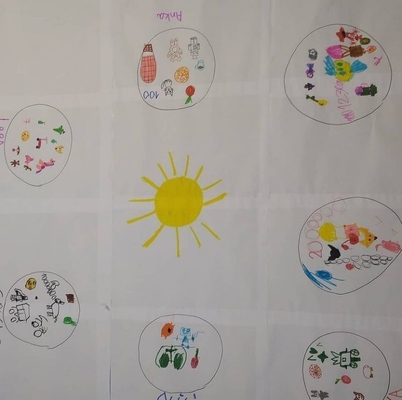
This started as an activity for the CLIL lesson devoted to space and Yuri Gagarin but after I published it on Instagram, one of my friends suggested that it might be a great idea for the end-of-year revision activity. And it is that, indeed. Thank you, Rory!:-) Hence this post.
Ingredients
An A1 piece of paper although, to be perfectly honest with you, it never is that. Every time I have made any murals (and that’s what this activity really is), the preparations started with a pile of A3 sheets of paper, a roll of scotch or a glue stick. It is easier and faster (no shopping trips) and more adaptable (because the teacher is in charge and the poster can be made bigger or smaller, depending on the size of the group or the theme of the project).
Creative materials of your choice – pencils, markers, finger paints or watercolours. This time we used markers, in my opinion better suited to the age of the kids and the task.
A place where all the students can draw simultaneously. In my classroom, we use the space in which we normally do the movement activities because we have a big carpet there and it is always a lovely variation to our everyday routine, both for the little kids or the teenagers that like visiting another classroom from time to time. A big conference table or a set of desks put together will be a great solution, too.
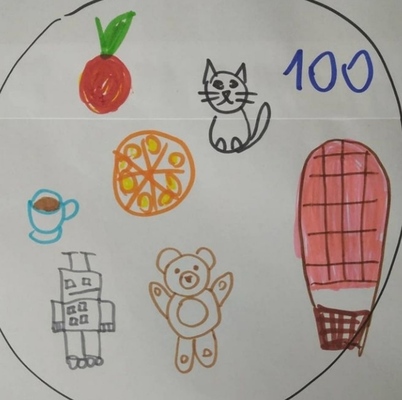
A decision as regards what language, vocabulary and structures, you are going to focus on in the task. In the original task, we created our planets with all our favourite things, our favourite number, colour, food, drink, animal, transport etc.
It is necessary to stage the activity carefully. The kids sit down on the floor around the poster, the teacher draws the sun in the centre and counts the kids and then draws one planet for each child around the sun. In the first step, each child chooses a marker and writes their name. Then the teacher ‘dictates’ the first topic and the kids draw it and say what they are drawing. In my classes, we use the song for that ‘What’s your favourite colour?‘ by Super Simple Songs and its variations because it offers the question – answer set (‘What’s your favourite…?’ ‘I like….‘). For some kids it is necessary to sing, some are better prepared to respond to questions without the support of the music. The teacher waits for everyone to finish each stage and the fast finishers can be encouraged to draw more than one item, to look at other students’ drawing, react to them (‘Do you like…?’) etc.
Round-up: If there is time, the students stand in a circle around the poster, first at their own planet and then, on ‘1..2..3! Let’s fly!‘, they move one planet to the left. Everyone reacts to what they can see on the new planet, for example ‘I like…‘ This stage can be repeated a few times, depending on the time available. Afterwards, the poster is displayed on the wall. It can also be used as part of the presentation for the parents in the following lesson.
Why we love it
First and foremost, it is a great project for the whole group and it really does contribute to building the community and that is because of the fact that we all sit around one big piece of paper and because of the concept of this activity – a solar system of which all the students and the teacher are a part.
It might be especially suited as the first project work for a pre-school group as everyone has a chance to contribute to the project but it is automatically clear that no one can take the final product home, as first of all, from the very beginning it is obvious that there is only one copy, that it is too big and that all the planets stay a part of the system and cannot be separated. Frequently, this issue can be the biggest problem with the project work for the youngest of students as they become attached to their creations and the first question they ask is ‘Anka, but can we take it home?’. Not this time.
The activity itself in its original version is very flexible as its timing will depend on how long the children are interested. Perhaps only three elements will be included, perhaps ten. The format of the activity also helps with staging as the children do not know what is to come and will not start going ahead of the group.
The song format helps to encourage the kids to actually produce the language, especially that in our case we used this question-answer set beforehand so at the time of this particular lesson, the children were already used to it and used to responding to it.
It can be used with all age groups and levels as the language content can easily be adapted either to more complex ways of discussing favourite things, drawing their own planets to practise the vocabulary of the natural world (with a more extensive presentation at the end of the project), creating a planet which is a symbolic representation of each student. For the older students, the planets can be filled in with words, rather than with images.
They are growing up. My students are no longer the little babies they were when we said our first ‘Hello!’. Six years is a long time, after all. And because they are changing, the lesson is changing, too. I like to think that, in a way, we are growing together.
An example? For five years and five months my students would wait for me outside of the classroom, in a neat line and we would check the homework and have a little chat, 1-1, with them slowly entering the classroom (more about it here). Well, not anymore. Two months ago we stopped. For good.
Because it turned out that, all of a sudden, the kids like to be in the classroom before the lesson. The choose their seats, take out their books, draw on the board or show each what they do in Maths classes at school. They also like to hide to surprise me (if I happen to leave to get some water or flashcards), walk around to inspect what I prepared for the day or just sit down and read they books.
And because over those six years we have managed to establish what’s OK and what’s not OK in terms of behaviour and because they have grown up and become more mature, I just let them do it and take over the classroom during the break. Plus, let’s be honest, they seem to be enjoying it a lot and I just don’t have the heart to forbid them and to continue to impose lining up.
Instead, I had an idea: how about a before-the-lesson activity for the early comers? It turned to be a very good idea indeed!
Ingredients
A whiteboard and a set of markers.
An activity that can be prepared on the board before the lesson for the students to work on potentially unsupervised (although in real life it differs, depending on whether I can be in the classroom during the break or not)
A set of easy instructions written on the board and an example
A longer break before the lesson – not obligatory but highly recommended
It might be necessary for the teacher to hint that there is something on the board that needs dealing with, at least when this part of the routine is introduced. It is quite likely that the kids would just not approach the board if there are any notes on it.
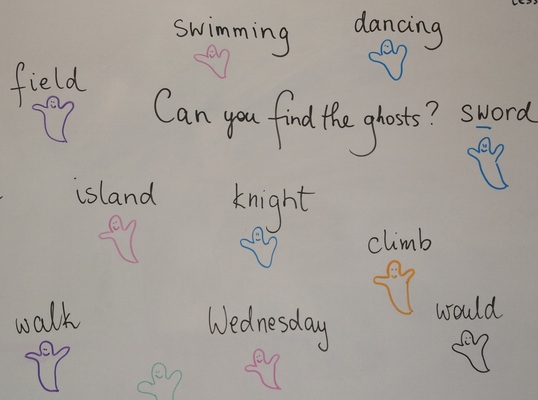
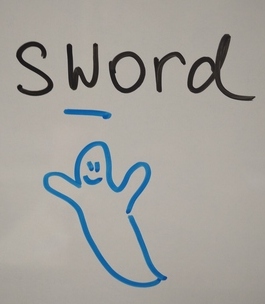
Ghost letters, focus: pronunciation. Students underline the silent letters in the words written on the board
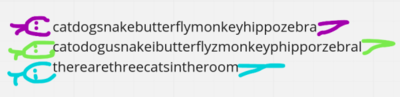
Letter snake, focus: reading / writing. Students divide the chain (or a snake of letters) into words. Each snake can be made as challenging as necessary ie only the words themselves, the words with letters-distractors, the words in a sentence.
Letter stories, focus: reading/ writing. Students divide the very long chain (or a snake of letters) into words and sentences. I used a different colour for each line of the story and neat breaks between the lines, too, not to overwhelm the kids. Forgot to take a photo:-(
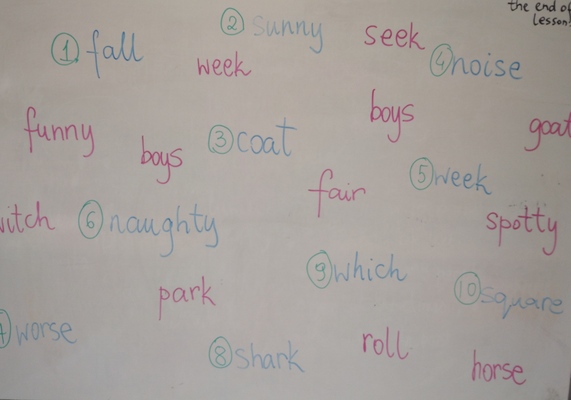
To rhyme or not to rhyme, focus: phonemic awareness. Students put the rhyming words into pairs. Again, colour-coding is supposed to be make is a bit more achievable and visually appealing.
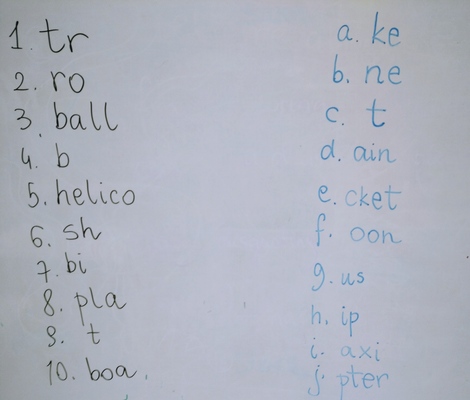
Messed-up, focus: vocabulary revision. Students put the halves of words together.
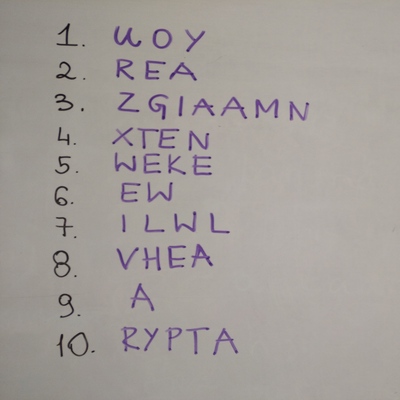
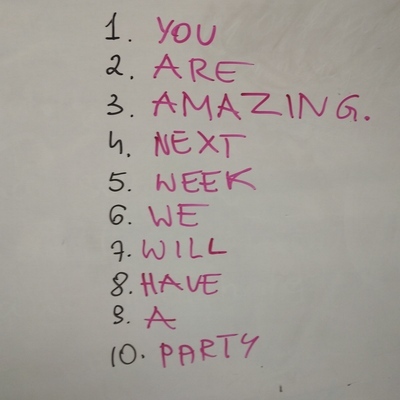
Angrams (and Secret Messages): These are just silly anagrams which are a nice task, more necessary for the Starters students but fun for everyone. It can be a set of random words, connected by the topic (or not) or sentences, especially if there is an especially important message that the teacher needs to pass on to the students. The message below appeared on the board before the second lesson with the mock Movers test, in an attempt to praise the kids and to motivate them. It worked!
Why we like it
Those who come early can wait for the lesson doing something in English.
They provide additional practice and revision in different areas and skills: reading, writing, vocabulary, pronunciation
Different kids come early on different days so they get to work in different pairs and teams which seems to strengthen the sense of community in the group
It seems to have become ‘fashionable’ to arrive early for class (not that it has even been a problem) but it is obvious that they have already developed the habit of walking in and checking what’s on the board
The teacher is applying all her creative powers to come up with more and more pre-lesson activities
‘Symbolic representation – making something stand for something else’*
Symbolic representation, its importance and development in children are a truly fascinating topic and one of the crucial ones to anyone who works with the little children.
Tina Bruce’s definition of symbolic representation has become the title for this paragraph and that means that absolutely anything can become a symbol of something else and being able to read these symbols is an important step in child development.
Symbols are everyone around us. Some of them are universally recognised such as mathematical symbols, musical notation or the letters of the alphabet, some are personal. While growing up, children are learning to differentiate between the symbol and the real object, they learn to recognise, learn and, eventually, to create symbols.
Examples? Imagine a cat, a black beautiful and soft murmuring creature. Now, imagine a flashcard of a cat. Obviously, as adults we have no problems differentiating between these two and understanding that the flashcard, no matter how realistic, is not a cat and that it only represents it. We can even take one step further and look at ‘CAT’ written on the board also understand that it is not the cat itself, only its symbol. Or that when we move one of our hands in the air (with the fingers spread apart and crooked a bit), while saying ‘meow’, we also want it to represent a cat. Although we are not the cat ourselves. One more step would be going in the direction of what the cat or the black cat itself might represent…
It is basically the development of abstract thinking. Why does it matter to us, the teachers of English? Well, there are a few reasons and a few immediate uses in the classroom.
Flashcards…
This is probably the easiest to highlight and, at the same time, the most obvious way in which the symbolic representation and its development influences our daily life in the classroom.
Flashcards are the staple resource of a VYL and YL teacher. We can bring toys into the classroom or plastic fruit to introduce and practice vocabulary with them but it is not possible with all the topics. Sadly, we can never have a real elephant or a real princess in the classroom, sadly, and for that reason we have flashcards. They help us work with the language as they are not only easy (or relatively easy) to obtain but they also help use the language and the variety of channels: visual (as they are colourful and pretty), kinesthetic (because we can manipulate them) and auditory (with the language produced by the teacher and the students).
However, there is the question of what exactly we want from the flashcards. They should be colourful and durable and visually appealing but they should also clearly convey the concept, not to confuse the children. The situation is much better nowadays, the materials that we work with are of a much better quality but you can still find a few ‘gems’ that should have never seen the daylight. I am collecting those and perhaps I am going to share with you my most precious finds (or rather ‘finds’).
It is a fascinating thing to be producing the flashcards to represent a less obvious concepts for example adjectives.
These first two are very straightforward, a frown is easily associated with ‘I’m sad’ or ‘sad’ and thinking of food with ‘I’m hungry’ or ‘hungry’.
The other two were a bit more challenging but I did assume that an owl is considered to be a very wise animal and it is often used in such a way. That is why we have also adopted it in our class. The other was even more challenging but I assumed that kids (or not only kids) often cover their eyes when they are scared and don’t want to look at what frightens them (although they sometimes peek through the fingers nonetheless:-). This is how we have ended up with these two symbols for ‘I’m clever’ and ‘I’m scared’ (or ‘clever’ and ‘scared’).
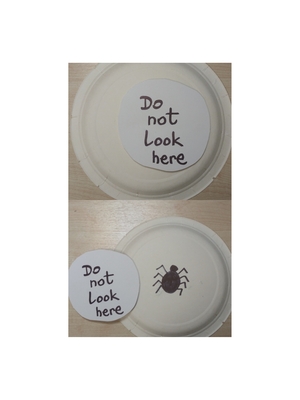
But things got really interesting and challenging recently. I needed a flashcard for ‘It’s scary’ (or ‘scary’) because we are in the unit of pets and animals and we learn to describe them, including what they like to eat, what they can do and what we think of them.
I already had a flashcards for ‘I’m scared’. For a moment I was considering using an image of a monster but those nice ones were sweet and funny and those that were really scary and illustrating the concept well, they were just too scary, even for me. In the end, I decided to go for a spider (as most kids don’t like them and I hate them so my reaction to them is always very real) but I covered it with a flap. My reasoning was that if something is scary, we don’t really want to look at it. So far it works well. And my kids love to pull off the flap while telling me that it is NOT scary.
Gestures
The gesture is king! By adding gestures while teaching kids vocabulary or structures, we multiply the number of channels through which the kids are operating (visual – with flashcards, auditory – the words spoken and kinesthetic – through gestures) and we help them remember and recall the language with more ease.
It does not really matter if we use gestures (or symbols) that are universally recognised. It is an advantage if we can, of course, but I doubt that any culture has a gesture ready for the vocabulary that you are studying at the moment, for example ‘It is snowing’, ‘it is windy’ or ‘a clown’, ‘a doctor’, ‘a princess’. It does not really matter, though. The English classroom is a sort of a bubble, a mini-universe where its own rules apply. It is almost natural that this world will have its own set of symbols or gestures.
I have already committed a separate post on different ways of using it with preschoolers learning English as a foreign language. You can find it here.
Vocabulary and structure or How to teach grammar to preschoolers
Symbols and their application can be especially useful while teaching grammar to preschoolers. First of all, taking the students out of the one word production world and into the phrase- and the sentence- or perhaps even the discourse-level is a challenge all by itself. Our EFL students have a limited class time (unlike the bilingual or the ESL children) and a limited exposure outside of the classroom. Second of all, pre-schoolers are indeed very young and their cognitive skills and the ability to deal with abstract concepts (such as grammar) are limited. Last but definitely not least, they are pre-literate in English and the structure cannot be just presented to them using the written word. Primary children, who learn grammar but depend heavily on the context (which is an advantage and a source of support), still receive the basic form of the target langauge on the board or in the coursebook for example ‘I like…’ which helps them remember the key structure and which supports production.
For that reason some other solutions have to be found and, at least, for me and my students relying on symbolic representation has been a life saver.
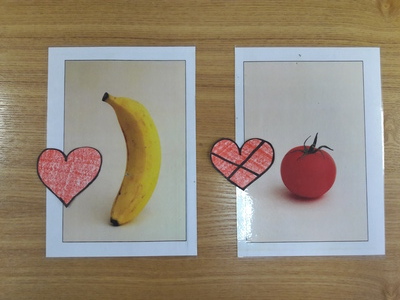
It started with a heart, you could say. I needed a symbol to stand for ‘I like’ and ‘I don’t like’ and at first I went for something resembling a face of a child that might be saying ‘Yummy’ but when I brought them to school, my students looked and said ‘happy’. Not good at all. The distance between the symbol and the real thing was too long and our new symbol resembled another symbol too closely. This is how we ended up with a heart – a coloured-in heart and a crossed heart to stand for ‘I like’ and ‘I don’t like’ respectively.
We use them together with the food, pets or colours flashcards and they simply work wonders. Both main components of the sentence are represented here visually, it is easier to remember them, to produce and reproduce them and they can be manipulated physically, too, as each of the students can have their own heart, double-sided. The heart can be put on the flashcard face up or face down depending on how the kids feel about it. It can be also held up, show the other students ‘the right side’.
It is amazing to see how quickly students accept this particular symbol and how effectively they use it. It is even more amazing to witness how they try to adapt it to the situation to make sure that they express their opinion and that this opinion is also reflected in how the symbol is used. In one of my groups we were using it with more complex food items and one of students said that she didn’t know whether she liked steak or not because shed had never tried. After a brief moment of hesitation, she decided to hold the little cardboard heart side-ways (or edge-ways) so that it expresses neither ‘I like’ or ‘I don’t like’.
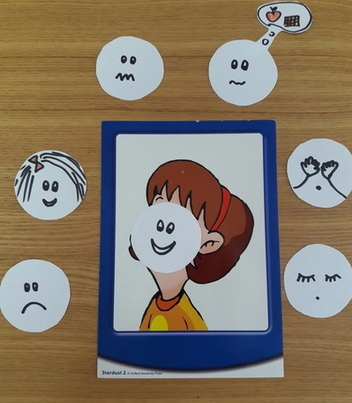
Another way of applying symbolic representation are the mini-emotion flashcards which we use to describe the feelings of others. These are quite small, small enough to fit on the character or family flashcards and to make it for almost ‘real’ experience when ‘mum’ looks really happy or sleepy or hungry.
These mini-cards can be used in phrases ‘a happy princess’ or in sentences ‘The princess is happy’ and the position of the card will reflect the change in the phrase ie if the card is on the left of the flashcards it reflects the position of both words in the phrase in which the adjective comes first. If the mini-card is on the flashcard (for the purpose of realism and fun) or on the right we produce a full sentence in which the noun comes first, followed by the verb ‘is’ (the only part that needs to be remembered and which can be represented by a gesture) and by the emotion.
Unfortunately, it is not always easy to find a suitable visual symbol for each structure we teach but it does not necessarily have to be a picture, gestures will work equally well. For example for ‘I’m wearing’ I motion my hand from my neck down to point at the clothes and for ‘I can see’ I tap my finger twice on my chest (for ‘I’ and ‘can’) and then point at my eyes ‘(‘see’).
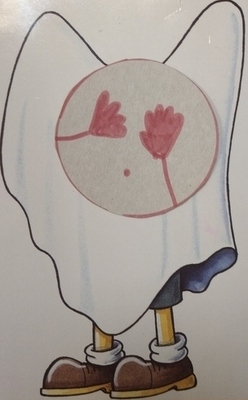
I think it can be safely said that I am (slowly?) adding symbols to my collection. Plus, it is fun to make the ghost scared, for once and this lesson always puts me in a better mood.
And then there are letters, too!
Letters and alphabets or any writing systems are a fascinating set of symbols and, eventually, children get to know them, in their L1 and in English, too. When they are ready. This is an adventure that deserves its own post (or, indeed, a series of posts), soon, especially that when we take the first steps in the world of the written word, it is with a background in another alphabet and another set of symbols, some of which are the same, some of which are different and some of which are false friends because they look the same but they represent different sounds.
Developing literacy skills is as much a challenge as it is fun. Especially that children as young as four and five comment on the fact the English ‘Pp’ looks exactly like the Russian ‘Rr’ and that ‘Ww’ turned upside down turns into ‘Mm’ (well, at least the capital one). Or that ‘Xx’ is a Russian ‘Hh’ or ‘A cross, Anka! It looks like a cross!‘
More on that later.
Kids grow up…
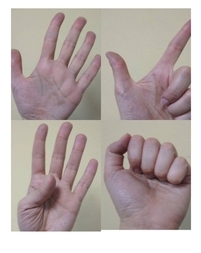
Of course the use of the symbol in the EFL classroom is not limited to pre-school, only later on the symbol is not an essential component (at least in my head) but a pleasant supplement that makes things fun, colourful and a bit easier. Examples? The ghost in the cover photo which we use with my primary kids to stand for the silent letters that started to appear everywhere in our A1 materials or the gestures that we used while learning and practising some basic adverbs of frequence: always (5 fingers – 5 days a week), usually, sometimes and never.
Happy teaching!
*****
If you are interested, make sure you have a look at these:
Symbolic Understanding in Infants and Young Children, a lecture by Dr Judy DeLoache (2013)
Symbolic Understanding in Infants and Young Children, a lecture by Dr Stephanie Carlson (2013)
Tina Bruce (2005) Early Childhood Education, pp 105 – 125