Crumbs #39 A lazy role-play

Ingredients

  • Any role-play or a dialogue i.e. a transcript of any listening task which is a dialogue (i.e. Movers listening part 2, part 3), any written dialogue (i.e. Movers reading and writing part 3), any functional langauge introduced in a dialogue or a role-play
  • A pencil or a highlighter for each child

Procedures

  • Start with the main aim of the task is, ie listening in case of task 3 of Movers or reading in case of Movers, introduction of the functional language, etc. Go through all of the stages outlined in the teacher’s book or whichever ones you see fit in your teaching context.
  • Give out highlighters or pencils, ask the kids to open the books and look at the text again.
  • Introduce the concept of a banana (or whichever random word you want to use). Explain (and demonstrate!!!) that you will read the text slowly with some bananas in it and that if the students hear the word ‘banana’ they have to highlight or underline one word that comes immediately afterwards. Model with a few words.
  • Read the text with the bananas as the kids listen, follow and underline or highlight. The words chosen to be highlighted are the key words for each specific dialogue and their number depends on the dialogue and on the age and level of the students. With the older students and the more complex texts and language, the students can highlight two or more words that constitute a phrase or a collocation. This can be signalled with a repeated number of bananas ie banana banana for a two-piece phrase or banana banana banana for a three-piece phrase.
  • Ask the students to work in pairs and read the dialogue again and to use their own words and phrases instead of every banana.
  • Afterwards the kids can change roles and read it again or change the partners.
  • If the kids are ready, in the final (and optional) stage of the activity, they can close the book and role play and recreate the dialogue and the converation based on what they remember.

Why we like it

  • It requires no preparation, unless by preparation you mean opening the coursebook and finding the role-play or finding the teacher’s book and making copies of the transcript of any listening activity
  • It offers a great opportunity for the students to practise their speaking skills in an activity that is both controlled (as we have a framework) and free (as there are quite a few options to choose from)
  • It also offers a chance to work on the grammar accuracy and the transformation skills
  • It can be done online or offline
  • It can be done with a variety of levels. The highest level I have used it with was B1 (teens), the lowest level, so far, was A2 (primary).
  • So far, I have only tried it with dialogues but now, writing that post, I started to wonder about the potential of that activity for discourse building and creation. The original text could serve as a potential framework and support for the students to use. I am yet to experiment with that option.

Happy teaching!

Crumbs #38 A – Z Game

Ingredients

  • A piece of paper and something to write with
  • All the letters of the alphabet written in one or two columns, with some space to write, next to each letter

Procedures

  • The teacher divides the students into pairs or teams and gives out the paper with the letters of the alphabet or asks the kids to write these down.
  • Step 1: The teacher announces the topic i.e. Clothes and asks the kids write one word (or phrase) for each letter of the alphabet or, more realistically, for as many letters as they can. The teacher gives an example. Ideally, the teacher creates her/his own list in order to have a set of words to model the other stages of the activity.
  • The teacher sets the time limit (i.e. 5 minutes for the younger kids and 3 minutes for the older kids). It might be a good idea to use a song instead and after the song finishes, the activity does, too.
  • The kids work in teams and make a list of the words within the vocabulary set. After the time is up, the teacher stops the game.
  • Step 2: The kids exchange the lists and count the words or phrases which their friends have managed to write within the set time limit. The teacher writes the results for each team on the board.
  • Step 3: The teams read the words on the lists and choose: the most interesting word, the most unusual word, the funniest word, three words you also have, three words you don’t have, any word you don’t understand or remember etc. The teams work in pairs and find out why their partners put these words on the list. If possible, the kids exchange the lists with another team and repeat the procedure once or twice.

Why we like it

  • For the students it is a great opportunity to revise and recycle vocabulary. All the beginner levels aside, even when the main lesson aim is to introduce and to practise new vocabulary, chances are the kids have already learnt, heard, used or seen some of the words. After all, the vocabulary sets are repeated and extended from level to level, not to mention that most kids have more than one source of English in their lives: the state school, the language school, a private teacher, brothers, sisters, parents, videos on youtube, cartoons, stories, computer games online…This game is one of the easy ways of revising all this vocabulary to prepare for ‘something new’
  • For all the reasons mentioned above, it is an absolute necessity for the teacher to find out how much the kids already know as regards a certain area in order to do a very focused (if a very contained) needs’ analysis and to adjust the volume, the level and the intensity of the new material presentation later in the lesson
  • It is very easy and requires no preparation whatsoever.
  • It helps to improve the students’ self-confidence because it gives them an opportunity to see how much they know already.
  • It can be used with any set of vocabulary, either thematic (i.e. clothes, food, animals) or content-related (i.e. the words necessary to describe a picture, the words used in a certain text or a listening task, a video)
  • The final task can be easily adapted i.e. choose 5 words to describe yourself, choose 5 words to use in a story or in a dialogue, choose 5 and describe them for your partners to guess, use a dictionary to find the words or structures for the missing letters, compare the lists with your friends to find the words or the structures for the missing letters, use the words to describe a photograph, use the words to talk about your day today etc.

Happy teaching!

Crumbs #37 We are going to the beach! A summer lesson for pre-schoolers

Ingredients and procedures

  • Few. Depending on what you can find at home
  • The lesson plan with all the ideas can be found here

Why we like it

  • Little preparation, only a few items of realia
  • A great lesson for the summer months
  • Works well with big groups
  • Lots of movement, the whole lesson is based on gesture
  • Lots of potential for production, especially if this lesson could be developed into a series of lessons
  • A fun lesson, we really went to the beach

Here you can read a bit more about the background of this lesson: How do you know that you are an experienced teacher...

And here: Big Thanks to Ola for letting me scavenge her house in search of realia aka resources)

Crumbs #34 The Weird Echo game

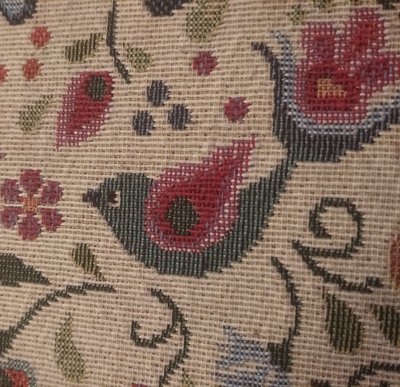
A beautiful bird from the folk embroidery patterns, traditional in the area of Kashuby (the north of Poland)

Ingredients

  • A grammar structure, for us it was the Present Perfect sentences with yet and answers with already and yet. If you are interested in the lessons that it was used, you can find out more here. I will present it based on this particular structure, but, naturally, the game can be used with a variety of structures, too.
  • A group of kids
  • The whiteboard where to present the pattern and the options, the online whiteboard or just a slide in your presentation.

Procedure

  • Introduce the structure in anyway you find appropriate. This time I actually used the coursebook materials (Superminds 5, CUP, Puchta and Gerngross) and the idea of the uncle sailor who has visited some countries and who has not visited some other ones, not yet anyway. And it must have been this activity that inspired me to come up with the game)
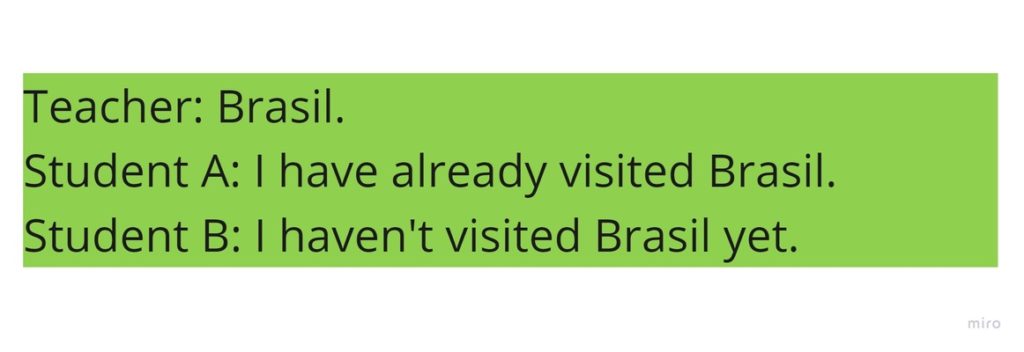
  • There is a set of pictures of all the flags in the coursebook and we used these flags in a simple controlled, drill-like activity: the teacher calls out the name of one of the countries, the kids (and the teacher) react by producing true sentences about themselves, based on whether they have visited these countries or not yet. The slide for this activity looked more or less like that:
  • After a few rounds, the kids take over and call out the countries from the list. After a few more rounds, they are allowed to call out the countries not included in the coursebook as well as any other places, countries, cities and famous places ie Germany, Dubai, Saint Petersburg, the Tretyakov Gallery etc.
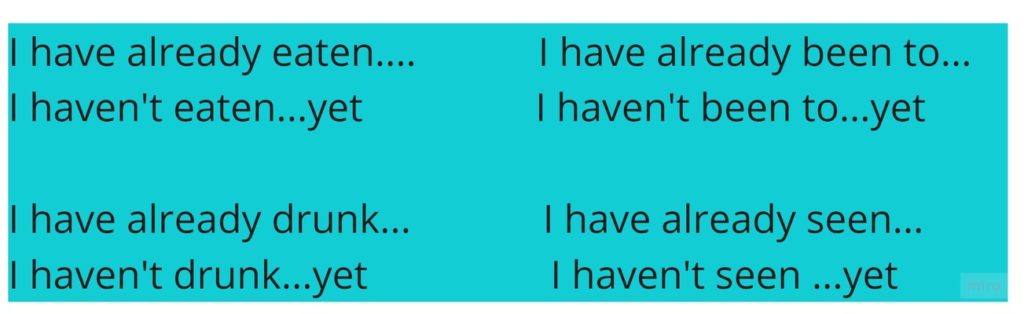
  • In the following lesson, we went one step further. And then more. After we checked the homework, I showed another slide, with four variations of things we have already eated, drunk, seen and the places we have been to that day. The slide looked more or less like that:
  • First, the teacher models the activity, with each of the versions, for example a banana, coffee, the bathroom, my friend and the students react, producing the relevant sentences. After that, the students take over and lead the activity.
  • All the other versions which may appear ie written a test are allowed.

Why we like it

  • The game is an opportunity to practise the target langauge in a controlled way with some (albeit not a lot) freer practice and some personalisation.
  • It is also an opportunity to drill the structure, to perfect the intonation and the sentence stress. It can be done chorally (the kids produce all the sentences together which is less risky and much safer, especially for the shy students) or taking turns. In real life, the activity was a mixture of both and I simply let it be, although, of course, the teacher can insist on either choral or individual production.
  • Very little preparation, if any. In the first part of the task, we were able to use the coursebook materials, the visuals (the flags) and the model sentences which were already on the page. The second part required the model sentences on display, at least in the beginning. This was the first time we played this game. I suppose these will be less necessary in the future.
  • There is a lot of potential for students’ involvement: first of all, they are personalising, sharing some details from their life. But of course, there is more to that – the students are also invited to lead the game and to suggest topics, places, food, things they are interested in. This also helps to make the activity memorable.
  • We did it as a whole class but it can be done in small groups or teams, too.
  • I created it for the lesson on the Present Perfect but I believe that it can be used with the other structures, with slight adaptations ie the Present Simple and the adverbs of frequency (T: watch the news, SS: I never watch the news, I always watch the news), the Past Simple structures (T: go to school, SS: I went to school, I didn’t go to school), or the adjectives to express opinions (T: Maths, SS: Maths is easy, Maths is difficult) etc.
  • My students are kids but I can see a lot of potential for this game with my adult beginners group, too.
  • The name! Of course I like it because I came up with it but I think it does reflect the principles of the game and it is its brief description: you echo but you adapt, too)

Happy teaching!

The Unsung Heroes of the YL classroom

Masking tape aka Painter’s tape

The funny thing is that I cannot remember when I discovered that the painter’s tape existed. Maybe it was Vita, my friend and my colleague who first brought it to school…

What I know is that for the past four years I have always had a roll of two at home and a roll or two at school. Because, right now, there is no classroom without the painter’s tape.

Every single time we do anything in the hallway, any kind of a treasure hunt, any jigsaw puzzle, anything which involves things being put up on the walls, the painters’ tape enters the picture. I prefer it to blutack because I don’t mind just throwing it out (instead of peeling it off carefully from every single scrap of paper) and, even more importantly, my students don’t feel tempted to nick the tiny little bits of the precious resource.

My primary students who are learning to read and write know this resource very very well. We use the tape to write instructions for different activities, especially if they needed to be displayed around the school and all our lessons would start with a fun activity with the little chairs – some of them would have the bits of the tape with funny words on them, for example choosing the place to sit (‘I am sitting on the Happy Octopus’), making sentences with the key word written on the chair (‘dancing’ – ‘Today I am a dancing hippo’) or even writing and creating random combinations of words.

Apart from that, pieces of the tape can be left on each table, one per student. They can be used in any kind of surveys (‘Which game would you like to play?’, ‘What was the most difficult part of the lesson?’) but I also noticed that the students liked to write on them, just to express themselves, to scribble while they were listening or to just to somehow personalise the table where they were sitting.

The tape can also be used to help group and pair the students. There should be a piece of tape on every desk and on these the teacher write the names of different superheroes (a very broad term in my lessons, it can include both Batman and Cheburashka, Harry Potter and Aleksander Sergeevich Pushkin, Lionel Messi and Santa). On entering the classroom at the beginning of the lesson, the students pick out one of the cards with the same name from the teacher and this is how they find out where they are sitting on the day. The same cards can be used later on to mix the students, with the teacher (or one of the students) picking out two cards to decide that in the following activity Superman will be working with Harry Potter and Robinson Cruzoe with Superman etc.

AND, though there are no photos, the painter’s tape was THE LINE on the carpet that helped my little babies sit in a safe and appropriate distance from the big TV on the floor.

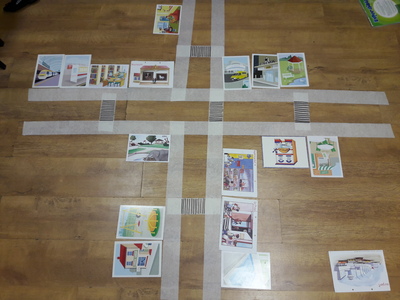
Last but not least, we have used it to create a city plan on the floor which we later filled in with flashcards and we used to move around. It is a rather limited use, but, oh what an amazing lesson.

The door

The door is the most underestimated and underloved part of the classroom. And how undeservedly so! Even if you have only the most standard door (not those double door straight from a castle), that is a good two square meters of a notice board, ready to use! It would be recommended to check the material, the surface and the ‘stickability’ and to test different adhesive materials that will not destroy the door itself but there is scotch, there is the painter’s scotch and there is blutack to name at least a few that could be used here.

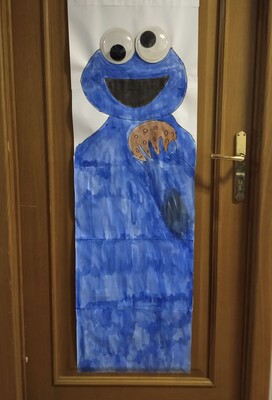
In my classrooms we have used the door in the following way: putting up the huge posters to use instead of the numbers (The Caterpillar Classroom, The Baby Shark Classroom, The Cookie Monster Classroom), putting up the homework poster (‘Did you do your homework?), putting up the washing line with all the clothes to use during (‘Today I am wearing…’), putting up the classroom rules posters, the library reviews poster (for the kids to leave the reviews after they have read something), the test feedback poster (‘How difficult was the test? 10 – very difficult, 1 – not difficult at all) and any class surveys completed on the way out, the sight words reading practice on the way in, displaying the alphabet poster when we were just starting to read, displaying any of the work that the students produced (when the walls were already taken) and, last but not least, or quite the contrary: the first ever: The Door of Doom aka the poster we created with my FCE students by adding bits and pieces to the poster throughout the course. These bits and pieces were all the things we struggled with: the mean phrasal verbs, the less common suffixes, the collocations that we would always make a mistake with and so on.

Next time you are in the classroom, have a look at the door and at this whole unused space…And what you could do with it. Once you start, you will never stop.

Counting sticks

This entry is perhaps not such a great surprise. After all, all the little people (and their teachers and parents) are very familiar with these colourful plastic sticks. Everything else aside, this should be one reason to be including them in our EFL lessons.

We use them mostly to count, of course, the kids pick two or three or twenty and this helps to make such an abstact idea as numbers a little bit more visual (because three items lying on the table, three sticks, three fingers or three dots on the dice are a better representation of the secret that this symbol ‘3’ stands for) and kinesthetic when we let the kids manipulate the sticks. Luckily, the sticks are cheap and easy to get so having lots and lots of them, enough for everyone, is not a difficult aim to meet.

One of my favourite games to play (perhaps because it is a perfect solution for a lazy teacher) is using these together with the paper plates with numbers. The kids look at the number, count the sticks and add or take them away, in order to make sure that the number matches the number of sticks. Which is also the beginnig of adding and substracting.

By the way, flashcards will do here, too, but the plates have the advantage of having the rim and the sticks do not slide off and you can easily just pile them up on top of each other, put them aside and sort them out after the lesson.

With my ‘adult‘ pre-primary kids, we have used these same counting sticks to help children manage a pair-work activity, to add a visual and kinesthetic element to the verbal exchange. We were practising different varieties of ‘What’s your favourite…’. The kids were sitting in pairs, on the floor, around a set of flashcards that would symbolise the themes (an apple for ‘What’s your favourite fruit?’, a teddy for ‘What’s your favourite toy?’ and so on) and one student in each pair would get a set of five sticks. They were supposed to ask their partner five questions of their choice (we had ten categories) and while doing that, they were supposed to put the stick away, on the relevant card. We used a similiar tool when they were interviewing their partners about things they like (‘Do you like…’ + any words of the kids’ choice) and I guess it can be adopted to pretty much any structure.

Plastic cups

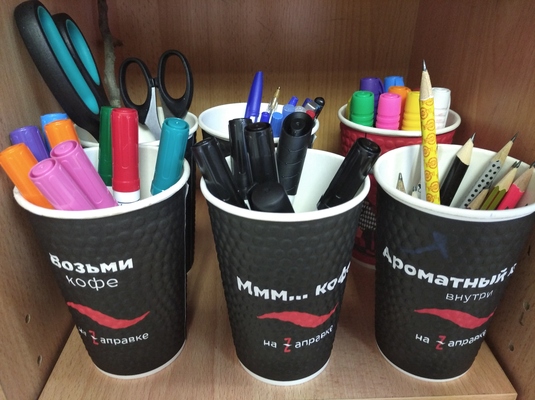
Or any other recycled cups (like those in the photo) which are easily available. They are my favourite resource to sort out materials (pencils, pens, bits and pieces for a craft activity, especially the leftovers, which I hide in the cupboard for later). They also help to organise materials which I give out to the kids, for example we have a set of boxes with crayons organised by the colour, for some, more teacher-centred activities, as here the teacher is the one in charge AND a set of cups organised in sets, one full set per student, which we use in all the SS-centred activities in which the students make decisions which colour to use.

With my older students, I use the plastic cups whenever we use dice in class (and that is often). The dice given to students (kids and teens) ‘just like that’ have the most amazing ability to fall off the tables about once per minute. Plus they make LOTS and LOTS of noise and if you have a group of then and five dice are rattling and rattling…Well, you can imagine. If you put each dice into a plastic cup, you can still shake it and get a number and everything is more manageable. I think I saw it first in Nataliya T’s class and here are my thankyous for this idea!

Paper plates

Oh the paper plates! They are of course used at parties and in craft lessons to make clocks, spinners, plates for all the ‘fruit salad’ craft activities, snowmen, frogs, chicks, rabbits and what not…But there is so much more!

For me it was this one day when I got an idea for a great lesson for which I really needed the number flashcards. These, however, were left behind in the office, so getting them for the lesson that was the first lesson of the day, early in the morning was out of the question. I rushed to the school cupboard in the house, to go over all the treasures there, with the idea of something that could help me replace the flashcards and there they were – a set of colourful cardboard plates from my local supermarket (which I must have bought for some class party earlier). Creating the flashcards took three minutes and a permanent market and it turned out that these particular plates (many of which I bought later on in the same supermarket) were perfect for it: big, durable, colourful but not too colourful since there was a thick colourful rim but the centre was just white and empty aka perfect for writing!

We normally use the number plates like any other flascards, first and foremost but the different shape adds to the variety and makes the topic of numbers a bit more fun. We also use them together with the counting sticks (see above) or with any other bits. We used the numbers 1 – 12 to create a huge clock on the floor and we played some movement games with it.

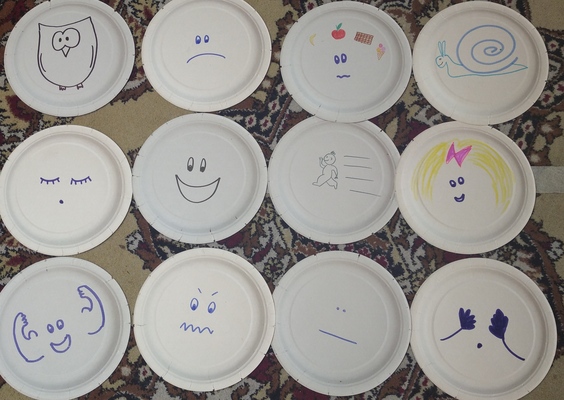
The plates became the canvas that helped me create my amazing emotions and adjectives cards (sorry about blowing my own trumpet here but there is a lot of love here) which we have been using for more than two years now.

Not to mention that the plates can be a very useful tool to organise all the bits and pieces while getting ready for a craft activity, hats for the snowman on one plate, scarves for the snowman on another, and they all can be stuck on top of each other. And, as you know, every little helps to make the teacher’s life a bit easier.

What are the unsung heroes of your classroom? Please share!

Happy teaching!