Teacher roles, teacher personalities.

This is not a serious post.

There is no need for anything else serious now, not with the amount of work related to the end-of-year procedures, the amount of work related to the summer programmes kick-off or the very important teacher training course that has just taken off. If there are any posts to come in the next few weeks, they will be all of the following kind: light-hearted, frolicky, with a giggle.

A teacher = a chameleon, a teacher = a jack of all trades, a monitor, a manager, a mediator, a diagnostician and a teacher, experienced or not, talented or not, on a good day or on a bad, this very person juggles all these roles and a teacher multi-tasks, playing a few roles at the same time.

But there are the other roles that a teacher plays in the classroom. Here are mine.
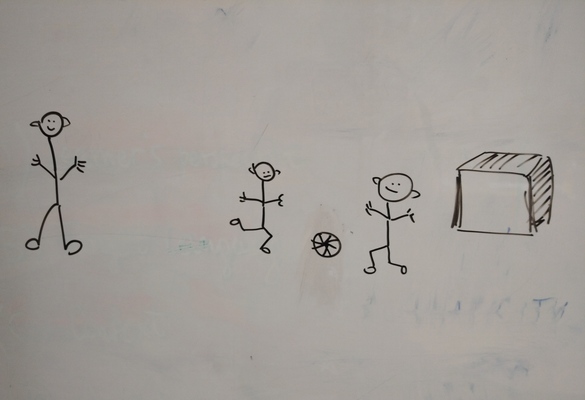
I’m a coach.

I work hard with my players. Whenever they are there, I am there, at every single training session, those technical ones, those devoted to developing speed and agility, those before the important game. I have been a player myself, I know what it all feels like, I have learnt how to share this knowledge. I am sometimes light-hearted, sometimes very serious but I know what our aim is and I am going to do everything to get us there.

But, at the same time, I am not the one who is going to play this important game. I am preparing my sportsmen but they are the ones who will be performing themselves. I will not be able to be there and always hold their hand, not on the pitch. They will be on their own and they need to get ready for that. Our time in the training session has to focus on that, on giving them skills, developing their independence and confidence. And then they go.
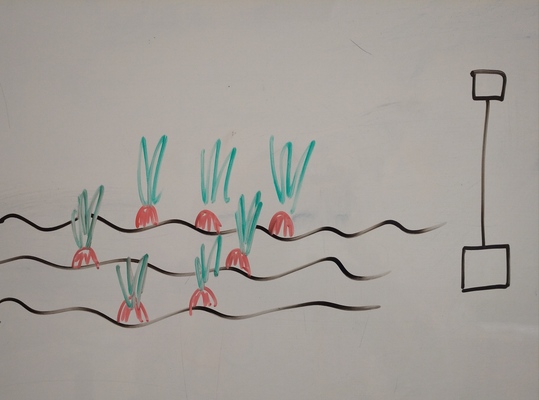
I’m a gardener.

I have my patch, my garden, my orchard. I plant my seeds and my saplings. I hope for the sun and good weather. I water, every day or even twice a way. I protect from the insects and birds. I check out for the weeds. I look and check up on them regularly. I wait. I wait. I wait. I wait. I wait. I wait. I worry about the wind, storm, temperature drops.

After a very long time and a lot of waiting, the day comes when a leaf appears, a flower, a raspberry here and a carrot there. And when it does happen, it is the best day every and I rejoice. And sometimes, I need to water more or move the pot into the sunnier place, or back into the house. Sometimes, I have plant the seeds again.
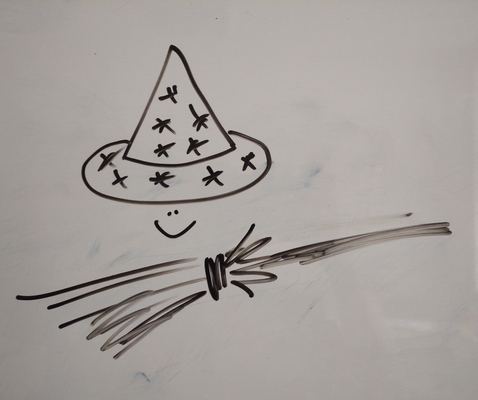
I’m a (kind) witch.

I am sweet (or so I would like to believe, at least when I am in the classroom:-) I smile a lot and I laugh a lot. I can turn a lot of difficult situations into a joke, to disperse the clouds. I wear funky socks and funky masks. Funky earrings, too. I am kind. I laugh a lot.

But I am also a witch and there can be no doubt (never ever) who is in charge, who is the boss and who has got all the superpowers. Which she will not hesitate to use. When necessary, the smile will be put away, on the shelf and the witch will do the witch’s things. If the world really needs it.

I know that these might be also referred to ‘teaching personas’ or ‘teaching personalities’ but I am going to stick to the concept of ‘a role’ here. Because ‘personality’ suggests something more serious (and that’s not the word for today, remember) and something more permanent and these described above are not traits, only characters that one assumes while entering the classroom. They can be different on different days, more or less prominent or obvious, they might appear every day or be held in the cupboards, kept for the special day…Perhaps we change as people because of the fact that we teach and that we teach English and that we teach English to kids and because of how we do it. Perhaps we choose our teaching roles based on what we are. Perhaps both. That is a conversation to be had on another day. Maybe.

In the meantine, if you want to share how you see yourself in the classroom, there is the comment box below. I am really looking forward to reading these.

Happy teaching!
The hidden perks of teaching EFL pre-schoolers

Author: Lisa, ca 2016
  • You will train yourself to be extremely well-organised. Never again will you forget to make a copy, to bring the crayons, to arrange the chairs or to pick up the realia from the teacher’s room. Why? Because once you enter the classroom and the kids come in, there is no going out, until the lesson is over. What’s more, all your toys and tools are most likely to end up in neat piles around the room, within an arm’s reach. One of the first things you learn in the VYL classroom is that there is never a minute to spare or, in that case, to look through the lesson plan or to search for the misplaced whatever. If it is not there when you need it, you just get on without it and make sure it is always there, in the future.
  • Apart from that, you will become very resourceful. No matter how carefully you prepare, things will happen and you will have think fast on your feet and come up of ways of making do without the CD player, the computer or the tablet, the glue or the storybook that got left in the bag. And you will, every single time and with time you will get amazingly good at coming up with last minute solutions. It will feel a lot like being about to do magic, actually.
  • You will become greener because you will find ways of recycling pretty much everything: milk cartons, chopsticks, ribbons, wrapping paper, pots, cereal boxes. Nothing will ever be thrown away. At your house and at your friends’ houses, too, possibly. Because as soon as they find out that you collect and recycle they will be bringing you things, including the unusual things that you will later try to use in class.
  • You will discover your hidden talents or believe in your so-far-unused talents for singing or drawing. Such a confidence boost! You will have to draw or sing at one point or another and what a revelation it will be to discover that those (little) people do not care which key you are singing in and they will just accept your involvement. As well as absolutely all your attempts at drawing a cat, a dog, a panda, a dinosaur…
  • Whether you were born with micro-staging skills or whether you have worked hard on crafting and polishing them, over every lesson with your preschoolers, eventually you are going to get there and you will rock at dissecting any random task or activity at a glance, down to the most minuscule details and, no matter how complex the task, your instructions giving skills and modelling will be simply first-rate.
  • You will enjoy any lesson with adults twice as much only because they: do not rock on chairs (even if they do, you are allowed not to care), they pick up the resources, flashcards, cards, notes and put them back together, with the paper clip on, they will not cry because there is only one pink pencil, they will open the book and find the page all by themselves, they will to the other side of the handout but they will still focus on the right page, they will not get irretrievably distracted by your earrings or by another student’s fluffy tiara…
  • You will learn that lesson planning should start in the classroom and with the students who are there, not just any typical 4-year-old beginners and not with the activities that the coursebooks authors intended for them. Typical 4-year-olds don’t exist and who turns up on Friday is Masha, Katya, Anya, Egor, Petya and Sasha. They are the lesson and if some pages of the coursebook are not compatible with the bunch in the room, these pages have to go. Good riddance.
  • You will quickly become a champion at devising a good plan B (or even a good plan C), to resort to in any given situation, an additional copy of the handout, a spare puppet in your Mary Poppins bag, a glue stick in the back pocket and, on top of that, three more ideas in your head. Just in case.
  • It is not going to happen automatically but once you believe and see that your little EFL students can go beyond one-word answers, beyond rehearsed and drilled lines and that they can use full sentences, complex sentences and can produce language spontaneously (because, yes, they CAN!), there will be no stopping you. Because if the pre-schoolers can, they absolutely everyone can! High five to the level of challenge!
  • Developing learners’ independence and involving them in the shaping of the lesson is something that the VYL do on daily basis. The kids learn to make decisions, choose their favourite games and songs and given the chance to be the teacher and lead the activities. This ‘democracy in the classroom’ (which I first heard about at the wonderful presentation given by Katherine Bilsborough) should be a part of the lesson with primary, juniors and teens. It really does work wonders!
  • A chance to forget about the traditional assessment in the form of tests, quizzes and standardised exams because the little people just don’t take part in those. Instead, the teacher can just focus on assessment for learning and start experimenting with all the alternative methods of assessment, better suited for the pre-literate, pre-school EFL students.
  • A unique opportunity to sing and jump and put on voices in the middle of the day and to forget about the world for a moment, about the mortgage, the heartbreak, the tiredness, the pandemic, about anything that is not the lesson and the students. Time out, for the teacher this time.
  • A new perspective on the world as you will be learning again to see the world from the height of 70 above the ground, getting lost among the pages of the book, forcing the pencil to stand still and to produce scribbles…Brand new world!

So here we have a resourceful, creative, green, well-organised, confident, calm, open-minded teacher who is great at giving instructions and planning student-centred lessons…Any student’s dream, right?

Happy teaching!

P.S. Here you can find another post on being a VYL and YL teacher…

What’s out there? Books and articles

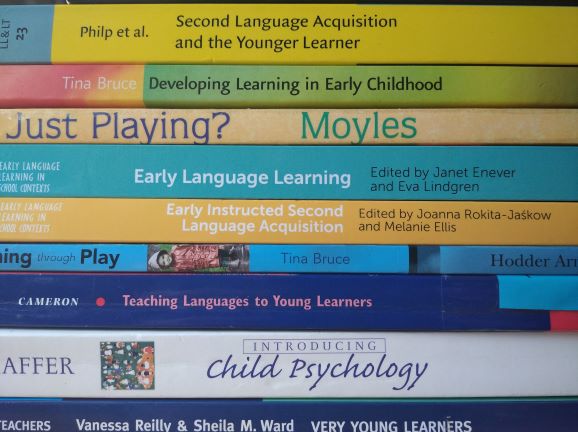
A reading list for the pre-primary EFL teachers (an attempt:-)

Here is a new project.

Deeply rooted in the fact that I keep losing things and if I start piling the resources here, I will also be able to find them myself easily. Selfish, as usual.

But, here’s to hoping that this post will come in handy to all those teachers who are looking for things to read about the very young kids and the ways of approaching them.

P.S. The list is highly subjective. So are the mini-reviews.

P.P.S. It will be continually updated!

P.P.P.S. Make sure you also have a look at the Bibliography Part 2: Webinars Treasure Chest.

Books: EFL

  1. Sandie Mourão and Gail Ellis (2020), Teaching English to Pre-Primary Children: Educating very young children, Delta Teacher Development Series. About: Waiting for my delivery but based on the IATEFL presentation in Liverpool, this book is dream come true.
  2. Vanessa Reilly and Sheila M. Ward (1997), Very Young Learners, Oxford University Press. About: Some nice practical solutions but, beware, the VYL world has moved on since 1997. Take it with a pinch of salt.
  3. Herbert Puchta and Karen Elliott (2017), Activities for Very Young Learners, Cambridge University Press. About: Lots of practical ideas for the beginner VYL teachers.
  4. Opal Dunn (2014), Introducing English to Young Children: Spoken Language, Collins. About: Some insights on what teaching pre-primary should be (although I cannot agree with all the approaches include here)
  5. Opal Dunn (2014), Introducing English to Young Children: Reading and Writing, Collins. About: Some theoretical background in a reader-friendly mode and some practical ideas.
  6. Lynne Cameron (2001), Teaching English to Young Learners, Cambridge University Press. About: Not really VYL-focused but an excellent introduction to the world of the non-adult learners.
  7. Sandie Mourão (2015), Discover with Dex, Teacher’s Book, Macmillan About: The best pre-primary Teacher’s Book so far (the overview of the age group, the implications for the classroom, the solutions).  

Research articles EFL

  1. Sandie Mourão (2014), Taking play seriously in the pre-primary English classroom, ELT Journal, 68 / 3, p 254 – 264 About: On the importance of play in the EFL/ESL environment.
  2. Sandie Mourao (2018), Research into the teaching as a foreign language in early childhood education and care, In: Garton, S. and F. Copland (eds), (2018), The Routledge Book of Teaching English to Young Learners, Milton Park, New York: Routledge, pp. 425 – 440. About: For those interested in a more academic look at EFL in pre-primary. Start your reading here! Spoiler alert: very little research in the area. Surprise surprise!
  3. Daeun Song and Jang Ho Lee (2019) The use of code switching for very young EFL learners, ELT Journal, 73 / 2, p. 144- 153. About: The results of a small scale study from South Korea on the benefits of the bilingual instruction in the pre-primary EFL classroom.
  4. Pawel Scheffler and Anna Dominska (2018), Own-language use in teaching English to pre-school children, ELT Journal, 72/4, p. 364- 383. About: The results of a small-scale study on the use of L1 in the pre-primary classroom in Poland (they do and they don’t mind).

Books: Early Years Education

  1. Tina Bruce (2015), Early Childhood Education, Hodder Arnold About: An absolute must. Nothing to do with EFL, lots and lots about the youngest learners in general.
  2. Tina Bruce (2001), Learning Through Play: Babies, Toddlers and the Foundation Years, Hodder Arnold About: A little more on play and why it matters.
  3. Tina Bruce (2004), Developing Learning in Early Childhood, Paul Chapman Publishing About: An introduction into the cognitive development, the social skills development, communication and the importance of play in early years education.
  4. Janet R. Moyles (1989), Just Playing, The role and status of play in early childhood education, Open University Press About: Even more on play, its types and value, including play with and through language.

Research articles: Early Years Education

  1. Developmental Matters in the Early Years Foundation Stage (EYFS), Early Education (2012), The British Association for Early Childhood Education, https://www.foundationyears.org.uk/wp-content/uploads/2012/03/Development-Matters-FINAL-PRINT-AMENDED.pdf   About: If you’ve never worked with the little people, have a look at this summary. This is how they operate. This is what they need.

To be continued…