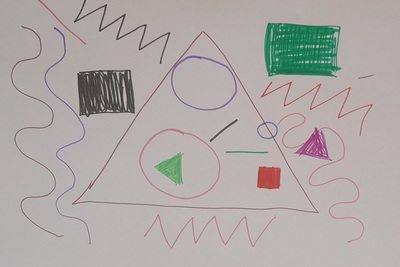
The truth is…I just wanted to do Art.
This year is different and now, or for now, hopefully, I am not teaching Art. And it was only before I came up with this lesson, with Kandinsky, that I realised how much I miss it and, that, really, at heart, I am the Art teacher. As if to confirm, shortly after that, I got a message from one of my students from last year and it went ‘miss Anka, you’ve been my favourite Art teacher and I miss our classes’.
So this is how I get back – to writing here (after a few months’ break) and to Art in class. I don’t have any full time Art in English classes but I have lots of English classes and I will be trying to bring Art into them. Starting with Vasilyi Kandinsky.
The language
We are at the begining of our journey into English with my student and, so far, what we have at our disposal is some functional language, emotions and colours and that is basically what the lessons have been about. We practice a lot, we find colours around the room, we sing songs, we do some online colouring (in the mode of ‘you say, I click’) and we talk about it. But I really (really) wanted to include something practial and something creative. And this is when I remembered about the video from the 2nd edition of Playway to English (CUP, Puchta, Gerngross) and the storyline there: Max, the creature tries to make a picture but due to some mishaps he almost destroys it and gets very upset. Until he finds out that modern Art is basically non-figurative and that he created a masterpiece. I looked at his picture and I thought: Kandinsky!
The artist
With my student being 6, and with us studying online and still getting adjusted to the format of the lesson, I wanted to keep this part of the lesson short, just to include the bare minimum: introducing him by the name (there was a photo, too) and looking at ‘Composition number 8’ to call out some colours and patterns that we were going to use.
This stage can be extended, of course, it is a great piece for introducing and practising shapes, too and if your students are older, you can also include the music connections (apparently, this one got inspired by Debussy’s music, and there is another lesson that I taught based on that, here). We just went on to create.
Here is the original amazing piece.
The art
Before the lesson, I asked the student’s mum to prepare a piece of paper, a pencil and crayons for us and when the time came, we went through the list to check that everything was there (‘Have you got…?, with me showing my bit to the camera, and waiting for the student to show hers).
For this particular lesson, I chose seven different patterns that we would draw: a circle, a square, a triangle, a rectangle, a line, a zigzac and a wave. I drew them on my presentation and we looked for them in the painting. Then I told my student that we are going to draw three of each, with different colours and we started.
Each element was executed in the following manner:
- the teacher calls out the pattern and demonstrates drawing to the camere on the demo sheet
- the teacher chooses three markers / crayons, shows them to the camera and then draws on the actual piece of paper, i.e. a yellow circle, a green circle, a red circle, in the most random manner (seemingly, because, of course, all this time we are working on the composition:-)
- the teacher asks ‘What about your colours? Show me three colours (pause) and draw three circles’
- the student completes the task
- the teacher describes her picture (I’ve got a yellow circile, a green circle, a red circle)
- the student tries to describe hers in the same way
- and we move on to the following item on the list.
It might seem that there is a lot of commentating here, on the part of the teacher but it is done on purpose. The aim of this task is to create something that the student will want to talk about and to model the language that we are hoping to produce. Without it, it would be just a lesson of drawing (which is amazing) but since it’s a language lesson, we (I passionately, obsessively and lovingly) strive for more language production. Always.
I prepared seven items to draw (times 3) but I was ready for the option of not including all of them if the student got tired or lost interest, especially that it was our first Art task in an online lesson and I was not quite sure how it might go. And Kandinsky, or any non-figurative painting, was perfect for that. On the other hand, if we had time, we could still add other elements such as stars, hearts, semi-circles, or shading. As it turned out – seven was just a perfect number for us and for that lesson.
I am really very happy with how it went. We managed to include all seven items, we went step by step and we produced a lot of language. She was quite involved in the process so there was no talking while drawing but, after each item was added, she showed the picture to the camera and told me all about it.
I loved the lesson (see: I miss Art in class!) and so did my student which I could see myself in class and which got confirmed after the lesson, in our chat with mum. I can’t show you her work but, as it often happens, it was much, much better than mine. You will just have to take my word for it this time.
So, if you are wondering, what kind of art to include in the beginning of the course for primary or pre-primary kids who speak very, very little English, Kandinsky is your man!
Happy teaching!